Back

College of Respiratory
Therapists of Ontario


INFECTION PREVENTION & CONTROL

Clinical Best Practice Guideline


March 2025

ACKNOWLEDGEMENTS

This Clinical Best Practice Guideline (CBPG) was first developed in 2008 by a working group of the CRTO’s Patient Relations Committee (PRC) comprised of practising Respiratory Therapists (RTs). The Infection Control Working Group for the first version of this CBPG was also assisted by Dr. Mary Vearncombe, Dr. Allison McGeer and the Infection Control Team at Mount Sinai Hospital.

ORIGINAL WORKING GROUP MEMBERS:

Neeta Fraser RRT,
Asthma Educator/ Pulmonary Function Laboratory, Trillium Health Centre, Mississauga.

Libby Groff RRT,
Manager of Ambulatory Cardio-Pulmonary Program, Women’s College Hospital, Toronto & Professional Leader, Respiratory Therapy, Women’s College Hospital and Sunnybrook Health Science Centre, Toronto.

Chris Harris RRT,
Team Leader, ICU, London Health Science Centre/ University Campus, London.

Ginny Myles RRT,
Sr. Polysomnographer & Community RRT, Royal Victoria Hospital, Barrie.

Lisa O’Drowsky RRT,
Manager, Patient Safety, St. Joseph’s Health Centre, Toronto

Rick Paradis RRT,
Charge Therapist, OR, Respiratory Therapy Department/ Anaesthesia, Mount Sinai Hospital, Toronto

Jodie Russell RRT,
Infection Control/Risk Management, Timmins and District Hospital, Timmins

Ian Summers RRT,
Faculty, Respiratory Therapy Program, Algonquin College, Ottawa

John Traill RRT,
Clinical Instructor, Mount Sinai Hospital, Toronto

Kelly Vaillancourt RRT,
Clinical Leader, Respiratory Therapy, McMaster Children’s Hospital, Hamilton.

CRTO STAFF

Mary Bayliss RRT,
Manager, Policy and Investigations

Carole Hamp RRT,
Professional Practice Advisor & Staff Respiratory Therapist, Guelph General Hospital

The CRTO is committed to ensuring that our standards and guidelines reflect the most current, evidence-based and best practices. Since the first version, the practice guideline has been revised twice. The CRTO would like to thank the following Professional Practice Committee and working group members for their participation and expertise that led to the updates to this CBPG.

INFECTION PREVENTION AND CONTROL CBPG REVIEW 2011

Professional Practice Committee (PPC)

Paul Williams, RRT
Council Member and PPC Chairman

Dave Jones, RRT
Council Member

Sherri Horner, RRT
Committee Member

Jim Ferrie
Council Member/Public Member

Infection Control Specialists

Jennifer Blue RRT,CIC

Jane Montgomery RRT

Michelle Stephens RRT

CRTO Staff

Jennifer Harrison RRT
Professional Practice Advisor

CBPG INFECTION PREVENTION AND CONTROL CBPG REVIEW 2016

Infection Control Specialists Working Group

Debbie Demizio RRT, BA, CIC
Infection Control Consultant, Public Health Ontario

Jodie Russell RRT, CIC
Infection Control/Risk Management, Timmins and District Hospital

Carol Turner RRT,
Clinical Engagement and Change Management, Chatham-Kent Health Alliance

Arpita Bhattacharya RRT, BSc RRT CIC
Infection Prevention and Control Practitioner, William Osler Health System

CRTO Staff

Carole Hamp RRT,
MA Manager of Quality Practice

CBPG INFECTION PREVENTION AND CONTROL CBPG REVIEW 2022

Professional Practice Committee (PPC)

Arpita Bhattacharya, RRT
Infection Prevention and Control Practitioner, Guelph General Hospital

Infection Control Specialist

Arpita Bhattacharya, RRT
Infection Prevention and Control Practitioner, Guelph General Hospital

CRTO Staff

Kelly Arndt, RRT
Manager, Quality Practice

QUESTIONS OR FEEDBACK?

    This Clinical Best Practice Guideline will be updated as new evidence emerges or as practice evolves. Comments on this guideline are welcome and should be addressed to:
    College of Respiratory Therapists of Ontario, 90 Adelaide Street West, Suite 300, Toronto, Ontario M5H 3V9
    Phone 416-591-7800 | Toll Free 1-800-261-0528 | Fax 416-591-7890 | E-mail questions@crto.on.ca
    INTRODUCTION

    The College of Respiratory Therapists of Ontario (CRTO), through its administration of the Regulated Health Professions Act (RHPA) and the Respiratory Therapy Act (RTA), is dedicated to ensuring that respiratory care services provided to the public by its Members are delivered in a safe and ethical manner.

    As regulated health professionals, Respiratory Therapists (RTs) are accountable for providing safe, competent, and ethical care to the public in accordance with the standards of the profession. This document has been developed to assist RTs in learning how to achieve quality infection prevention and control practices. The SARS epidemic in 2003, the H1N1 Pandemic in 2009, and the MERS and Ebola 2014/2015 outbreaks, 2019 Covid pandemic as well as the likelihood of another pandemic influenza – suggest it is vital for RTs to remain informed and up to date on current infection prevention and control best practices.

    In addition to the public and the CRTO, RTs are accountable to their employer. Employers may have additional policies and procedures related to infection prevention and control. If an employer’s policies and procedures are more restrictive than the CRTO’s description of the standard of practice, Members should abide by their employer’s policies and procedures. Where the employer’s policies and procedures are more permissive than the standard of practice described by the CRTO, Members should adhere to the standard of practice described by the CRTO.

    CRTO publications contain practice parameters and standards which should be considered by all Ontario Respiratory Therapists in the care of their patients/clients and in the practice of the profession. CRTO publications are developed in consultation with professional practice leaders and describe current professional expectations. It is important to note that these CRTO publications may be used by the CRTO or other bodies in determining whether appropriate standards of practice and professional responsibilities have been maintained.

    Guiding Principles of Infection, Prevention
    and Control

    RTs are accountable for….

    9

    Knowing how infections are transmitted (i.e., The 6 Links in the Chain of Transmission)

    9

    Adhering to the current infection prevention and control guidelines for their practice setting (e.g., employer policies, OHA Communicable Diseases Surveillance Protocols, Ontario Public Health, MOH Emergency Planning and Preparedness)

    9

    Advocating for best practices in infection prevention and control in their workplace

    9

    Educating and modelling proper infection prevention and control practices for others

    9

    Monitoring changes to infection control practices and updating their practice accordingly (e.g., MOH Health Bulletins).

    9

    Knowing their Immunization Status and keeping their immunisation records up to date

    9

    Ensuring that there are processes in place to obtain an accurate travel history from patients/clients

    Infection Control interventions are directed at:
    • Controlling or eliminating agent at source of transmission
    • Protecting portals of entry
    • Increasing host’s defenses
    u

    DID YOU KNOW?

    Institutional outbreaks involving staff have been reported, particularly with hepatitis A, cryptosporidiosis and norovirus.
    Health Care-Associated Infections | Public Health Ontario

    The principles necessary to prevent transmission of microorganisms from patient to patient, patient to healthcare worker (HCW) and HCW to patient, across the continuum of care include:

    9

    Consistent use of Routine Practices, including a Risk Assessment that takes into consideration the client/patient/resident infection status, the characteristics of the client/patient/resident and the type of care activities to be performed

    9

    Application of Additional Precautions, where indicated

    9

    Hand Hygiene and proper cough etiquette

    9

    Adhering to the principles of good occupational health and hygiene practices and reporting facility outbreaks, where appropriate

    9

    Ensuring appropriate immunizations are obtained

    9

    Avoiding consuming food or beverages in patient care areas (RPAP, 2012, p. 48)

    9

    Staying home from work when ill with symptoms of fever, chills, cough, malaise and/or nausea, vomiting or diarrhea

    Organizational Accountabilities :

    All health care settings should establish a clear expectation that staff do not come into work when ill with symptoms that are of an infectious origin and support this expectation with appropriate attendance management policies. Staff carrying on activities in a health care setting who develop an infectious illness may be subject to some work restrictions.

    u

    DID YOU KNOW?

    Staff who consume food or beverages in care areas (client/patient/resident environment, nursing station, charting areas) are at increased risk for acquiring serious foodborne gastrointestinal infections.

    References

    Association for the Advancement of Medical Instrumentation (AAMI). (2015). FDA proposes new criteria for surgical gowns. Retrieved from Association for the Advancement of Medical Instrumentation website: www.aami.org/newsviews/newsdetail.aspx?ItemNumber=2650

    Canadian Patient Safety Institute. (n.d.). Ventilator-associated pneumonia (VAP). Retrieved from Canadian Patient Safety Institute website: www.patientsafetyinstitute.ca/en/topic/pages/ventilator-associatedpneumonia-(vap).aspx

    Centers for Disease Control and Prevention. (2011). Central line-associated bloodstream infections: Resources for patients and healthcare providers. Retrieved from Centers for Disease Control and Prevention website: www.cdc.gov/HAI/bsi/CLABSI-resources.html

    Critical Care Secretariat. (2012). Ventilator associated pneumonia and central line infection prevention toolkit. Retrieved from Critical Care Services Ontario website: www.criticalcareontario.ca/EN/Toolbox/Performance%20Improvement%20Collaborative/VAP%20and%2 0CLI%20Toolkit%20(2012).pdf

    Immunize Canada. (2016). ImmunizeCA app. Retrieved from Immunize Canada website: http://immunize.ca/en/app.aspx

    Loeb, M., Dafoe, N., Mahony J., John, M., Sarabia, A., Glavin, V., Walter, S.S. (2009). Surgical mask vs N95 respirator for preventing influenza among health care workers: A randomized trial. JAMA, 302(17), 1865- 1871. doi:10.1001/jama.2009.1466. Retrieved from http://jama.jamanetwork.com/article.aspx?articleid=184819

    PIDAC. (2012a). Best practices for infection prevention and control programs in Ontario (3rd ed.). Retrieved from Public Health Ontario website: www.publichealthontario.ca/en/eRepository/BP_IPAC_Ontario_HCSettings_2012.pdf

    PIDAC. (2012b). Routine practices and additional precautions in all health care settings (3rd ed.). Retrieved from Public Health Ontario website: www.publichealthontario.ca/en/eRepository/RPAP_All_HealthCare_Settings_Eng2012.pdf

    PIDAC. (2013). Annex B: Best practices for prevention of transmission of acute respiratory infection in all health care settings. Retrieved from Public Health Ontario website: www.publichealthontario.ca/en/eRepository/PIDAC-IPC_Annex_B_Prevention_Transmission_ARI_2013.pdf

    PIDAC. (2014). Best practices for hand hygiene in all health care settings, (4th ed.). Retrieved from Public Health Ontario website: www.publichealthontario.ca/en/eRepository/2010-12%20BP%20Hand%20Hygiene.pdf

    PIDAC. (2015a). Best practices for prevention, surveillance and infection control management of novel respiratory infections in all health care settings. Retrieved from Public Health Ontariowebsite: www.publichealthontario.ca/en/eRepository/Best_Practices_Novel_Respiratory_Infections.pdf

    PIDAC. (2015b). Infection prevention and control for clinical office practice. Retrieved from Public Health Ontario website: www.publichealthontario.ca/en/eRepository/IPAC_Clinical_Office_Practice_2013.pdf

    PIDAC. (2016). Tools for preparedness: Triage, screening and patient management for Middle East Respiratory Syndrome Coronavirus (MERS-CoV) infections in acute care settings. Retrieved from Public Health Ontario website: www.publichealthontario.ca/en/eRepository/PIDAC-IPC_Preparedness_Tools_MERS_CoV_2013.pdf

    Public Health Agency of Canada. (2013). Canadian immunization guide. Retrieved from Public Health Agency of Canada website: http://phac-aspc.gc.ca/publicat/cig-gci/p03-work-travail-eng.php#a1

    Public Health Agency of Canada. (2014). Canadian Tuberculosis Standards (7th ed.). Retrieved from http://www.phac-aspc.gc.ca/tbpc-latb/pubs/tb-canada-7/assets/pdf/tb-standards-tb-normes-prefeng.pdf

    Public Health Agency of Canada. (2016). Summary of assessment of public health risk to Canada associated with Middle East Respiratory Syndrome Coronavirus (MERS-CoV). Retrieved from Public Health Agency of Canada website: www.phac-aspc.gc.ca/eri-ire/coronavirus/risk_assessment-evaluation_risque-eng.php

    Public Health Ontario. (n.d.a). Chain of transmission and risk assessment: Glossary of terms. Retrieved from Public Health Ontario website: www.publichealthontario.ca/en/LearningAndDevelopment/OnlineLearning/InfectiousDiseases/IPACCore/Documents/CORE_Trainers_COT_and_RA_Module_Glossary_April _2014.pdf

    Public Health Ontario. (n.d.b). Risk Algorithm to Guide PPE Use. Retrieved from Public Health Ontario website: www.publichealthontario.ca/en/eRepository/IPAC_Clinical_Office_Practice_Risk_Algorithm_PPE_2013.pdf

    World Health Organization. (2015). Middle East respiratory syndrome coronavirus (MERS-CoV). Retrieved from World Health Organization website: www.who.int/mediacentre/factsheets/mers-cov/en/

    Immunizations

    Appropriate vaccine use protects the health care provider, colleagues and the patient/client (Immunization (Vaccines) | Public Health Ontario).

    Examples of vaccines that may be necessary to protect RTs and their patient/clients:
    9

    annual influenza

    9
    Covid – 19
    9

    measles, mumps, rubella (MMR)

    9

    varicella

    9

    pertussis

    9

    hepatitis A, B

    9

    tetanus/diphtheria

    RESOURCE

    Immunize Canada offers an app that helps users record their vaccination information and access recommended immunization schedules.

    Professional Accountabilities:

    Health care workers (HCW), including hospital employees, other staff who work or study in hospitals (e.g., students in health care disciplines, contract workers, volunteers) and other health care personnel (e.g., those working in clinical laboratories, nursing homes, home care agencies and community settings) are at risk of exposure to communicable diseases because of their contact with patients/clients (diagnosed or undiagnosed) or their environment. There is also a risk that HCW could transmit an undiagnosed vaccine-preventable disease to others. Some health care institutions and jurisdictions are moving towards making vaccination a condition of employment for HCW. Public Health Agency of Canada

    References

    Association for the Advancement of Medical Instrumentation (AAMI). (2015). FDA proposes new criteria for surgical gowns. Retrieved from Association for the Advancement of Medical Instrumentation website: www.aami.org/newsviews/newsdetail.aspx?ItemNumber=2650

    Canadian Patient Safety Institute. (n.d.). Ventilator-associated pneumonia (VAP). Retrieved from Canadian Patient Safety Institute website: www.patientsafetyinstitute.ca/en/topic/pages/ventilator-associatedpneumonia-(vap).aspx

    Centers for Disease Control and Prevention. (2011). Central line-associated bloodstream infections: Resources for patients and healthcare providers. Retrieved from Centers for Disease Control and Prevention website: www.cdc.gov/HAI/bsi/CLABSI-resources.html

    Critical Care Secretariat. (2012). Ventilator associated pneumonia and central line infection prevention toolkit. Retrieved from Critical Care Services Ontario website: www.criticalcareontario.ca/EN/Toolbox/Performance%20Improvement%20Collaborative/VAP%20and%2 0CLI%20Toolkit%20(2012).pdf

    Immunize Canada. (2016). ImmunizeCA app. Retrieved from Immunize Canada website: http://immunize.ca/en/app.aspx

    Loeb, M., Dafoe, N., Mahony J., John, M., Sarabia, A., Glavin, V., Walter, S.S. (2009). Surgical mask vs N95 respirator for preventing influenza among health care workers: A randomized trial. JAMA, 302(17), 1865- 1871. doi:10.1001/jama.2009.1466. Retrieved from http://jama.jamanetwork.com/article.aspx?articleid=184819

    PIDAC. (2012a). Best practices for infection prevention and control programs in Ontario (3rd ed.). Retrieved from Public Health Ontario website: www.publichealthontario.ca/en/eRepository/BP_IPAC_Ontario_HCSettings_2012.pdf

    PIDAC. (2012b). Routine practices and additional precautions in all health care settings (3rd ed.). Retrieved from Public Health Ontario website: www.publichealthontario.ca/en/eRepository/RPAP_All_HealthCare_Settings_Eng2012.pdf

    PIDAC. (2013). Annex B: Best practices for prevention of transmission of acute respiratory infection in all health care settings. Retrieved from Public Health Ontario website: www.publichealthontario.ca/en/eRepository/PIDAC-IPC_Annex_B_Prevention_Transmission_ARI_2013.pdf

    PIDAC. (2014). Best practices for hand hygiene in all health care settings, (4th ed.). Retrieved from Public Health Ontario website: www.publichealthontario.ca/en/eRepository/2010-12%20BP%20Hand%20Hygiene.pdf

    PIDAC. (2015a). Best practices for prevention, surveillance and infection control management of novel respiratory infections in all health care settings. Retrieved from Public Health Ontariowebsite: www.publichealthontario.ca/en/eRepository/Best_Practices_Novel_Respiratory_Infections.pdf

    PIDAC. (2015b). Infection prevention and control for clinical office practice. Retrieved from Public Health Ontario website: www.publichealthontario.ca/en/eRepository/IPAC_Clinical_Office_Practice_2013.pdf

    PIDAC. (2016). Tools for preparedness: Triage, screening and patient management for Middle East Respiratory Syndrome Coronavirus (MERS-CoV) infections in acute care settings. Retrieved from Public Health Ontario website: www.publichealthontario.ca/en/eRepository/PIDAC-IPC_Preparedness_Tools_MERS_CoV_2013.pdf

    Public Health Agency of Canada. (2013). Canadian immunization guide. Retrieved from Public Health Agency of Canada website: http://phac-aspc.gc.ca/publicat/cig-gci/p03-work-travail-eng.php#a1

    Public Health Agency of Canada. (2014). Canadian Tuberculosis Standards (7th ed.). Retrieved from http://www.phac-aspc.gc.ca/tbpc-latb/pubs/tb-canada-7/assets/pdf/tb-standards-tb-normes-prefeng.pdf

    Public Health Agency of Canada. (2016). Summary of assessment of public health risk to Canada associated with Middle East Respiratory Syndrome Coronavirus (MERS-CoV). Retrieved from Public Health Agency of Canada website: www.phac-aspc.gc.ca/eri-ire/coronavirus/risk_assessment-evaluation_risque-eng.php

    Public Health Ontario. (n.d.a). Chain of transmission and risk assessment: Glossary of terms. Retrieved from Public Health Ontario website: www.publichealthontario.ca/en/LearningAndDevelopment/OnlineLearning/InfectiousDiseases/IPACCore/Documents/CORE_Trainers_COT_and_RA_Module_Glossary_April _2014.pdf

    Public Health Ontario. (n.d.b). Risk Algorithm to Guide PPE Use. Retrieved from Public Health Ontario website: www.publichealthontario.ca/en/eRepository/IPAC_Clinical_Office_Practice_Risk_Algorithm_PPE_2013.pdf

    World Health Organization. (2015). Middle East respiratory syndrome coronavirus (MERS-CoV). Retrieved from World Health Organization website: www.who.int/mediacentre/factsheets/mers-cov/en/

    The Six Links in the Chain of Transmission &
    Breaking the Chain of Transmission

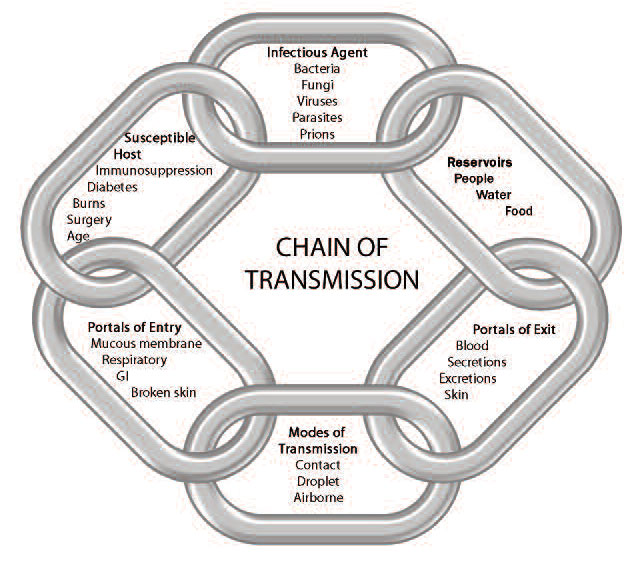
    Chain Of Transmission

    Each link in the chain represents a factor related to the spread of microorganisms. Transmission of infectious agents does not take place unless all six of the elements in the chain of transmission are present. Public Health of Ontario

    ©Queen’s Printer for Ontario, 2011. Adapted with the permission of Public Health Ontario.

    u

    Did You Know?

    Public Health Ontario has a set of free infection prevention and control learning modules.

    Infection Prevention and Control – Online Learning | Public Health Ontario

    The links in the Chain of Transmission can be broken through a careful Risk Assessment and consistent application of Routine and Additional Precautions, where indicated.

    Links in the Chain of Transmission are:Breaking the Chain of
    Transmission by Assessing:
    INFECTIOUS AGENTThe micro-organisms capable of producing infection (e.g., bacteria, viruses)The pathogenicity/virulence of the infectious agent
    RESERVOIRThe places in which the infectious agent lives (e.g., humans, animals, water)The patient/client’s environment (e.g., shared facilities, such as multi-bed rooms)
    PORTAL OF EXITThe point where the agent leaves the reservoir (e.g., blood, secretions)The potential for exposure to blood, body fluids, secretions and excretions (e.g. splashing, patient coughing) considering the duration of exposure (e.g., sterile gown for central line insertions)
    MODES OF
    TRANSMISSION
    Contact – which is divided into:
    Direct Contact – occurs through touch
    Indirect Contact – occurs when micro-organisms are transferred by contaminated object coming into contact with another surface
    the procedure(s)to be performed (e.g., hand hygiene & PPE required) and whether Additional Precautions are required
    • whether there will be contact with non-intact skin or mucous membranes
    • the potential for handling sharp or contaminated instruments or equipment
    Droplet Transmission – occurs when large droplets exit the respiratory tract of a person when they cough or sneeze. Can also be generated by some procedures (e.g., suctioning). These droplets are projected at a short distance of usually < 2m and enter the hosts eyes, nose, mouth or fall onto surfaces.
    Airborne Transmission – occurs when airborne particles remain suspended in the air, travel on air currents
    and are then inhaled by others who are nearby or who may be some distance away from the source patient, in a different room or ward (depending on air currents) or in the same room that a patient has left, if there have been insufficient air exchanges.
    Parenteral Transmission – the spread of an agent through intact skin by a sharp (e.g., needle stick injury).
    Common Vehicle Transmission – the spread of an agent through a common contaminated source (e.g., multi-dose vials)
    Vector Transmission – occurs when a host is bitten by an animal or insect carrying the infectious agent (e.g., mosquito transmitting West Nile virus)
    PORTAL OF ENTRYThe point at which the agent enters the host (e.g., non-intact skin, respiratory or GI tract, mucous membranes)The need for aseptic technique for invasive procedures and handling injectable products.

    The appropriate catheter and wound care
    SUSCEPTIBLE HOSTAny person at risk of infection (e.g., immunosuppressed patients, burn victims, elderly)The need for appropriate immunization
    References

    Association for the Advancement of Medical Instrumentation (AAMI). (2015). FDA proposes new criteria for surgical gowns. Retrieved from Association for the Advancement of Medical Instrumentation website: www.aami.org/newsviews/newsdetail.aspx?ItemNumber=2650

    Canadian Patient Safety Institute. (n.d.). Ventilator-associated pneumonia (VAP). Retrieved from Canadian Patient Safety Institute website: www.patientsafetyinstitute.ca/en/topic/pages/ventilator-associatedpneumonia-(vap).aspx

    Centers for Disease Control and Prevention. (2011). Central line-associated bloodstream infections: Resources for patients and healthcare providers. Retrieved from Centers for Disease Control and Prevention website: www.cdc.gov/HAI/bsi/CLABSI-resources.html

    Critical Care Secretariat. (2012). Ventilator associated pneumonia and central line infection prevention toolkit. Retrieved from Critical Care Services Ontario website: www.criticalcareontario.ca/EN/Toolbox/Performance%20Improvement%20Collaborative/VAP%20and%2 0CLI%20Toolkit%20(2012).pdf

    Immunize Canada. (2016). ImmunizeCA app. Retrieved from Immunize Canada website: http://immunize.ca/en/app.aspx

    Loeb, M., Dafoe, N., Mahony J., John, M., Sarabia, A., Glavin, V., Walter, S.S. (2009). Surgical mask vs N95 respirator for preventing influenza among health care workers: A randomized trial. JAMA, 302(17), 1865- 1871. doi:10.1001/jama.2009.1466. Retrieved from http://jama.jamanetwork.com/article.aspx?articleid=184819

    PIDAC. (2012a). Best practices for infection prevention and control programs in Ontario (3rd ed.). Retrieved from Public Health Ontario website: www.publichealthontario.ca/en/eRepository/BP_IPAC_Ontario_HCSettings_2012.pdf

    PIDAC. (2012b). Routine practices and additional precautions in all health care settings (3rd ed.). Retrieved from Public Health Ontario website: www.publichealthontario.ca/en/eRepository/RPAP_All_HealthCare_Settings_Eng2012.pdf

    PIDAC. (2013). Annex B: Best practices for prevention of transmission of acute respiratory infection in all health care settings. Retrieved from Public Health Ontario website: www.publichealthontario.ca/en/eRepository/PIDAC-IPC_Annex_B_Prevention_Transmission_ARI_2013.pdf

    PIDAC. (2014). Best practices for hand hygiene in all health care settings, (4th ed.). Retrieved from Public Health Ontario website: www.publichealthontario.ca/en/eRepository/2010-12%20BP%20Hand%20Hygiene.pdf

    PIDAC. (2015a). Best practices for prevention, surveillance and infection control management of novel respiratory infections in all health care settings. Retrieved from Public Health Ontariowebsite: www.publichealthontario.ca/en/eRepository/Best_Practices_Novel_Respiratory_Infections.pdf

    PIDAC. (2015b). Infection prevention and control for clinical office practice. Retrieved from Public Health Ontario website: www.publichealthontario.ca/en/eRepository/IPAC_Clinical_Office_Practice_2013.pdf

    PIDAC. (2016). Tools for preparedness: Triage, screening and patient management for Middle East Respiratory Syndrome Coronavirus (MERS-CoV) infections in acute care settings. Retrieved from Public Health Ontario website: www.publichealthontario.ca/en/eRepository/PIDAC-IPC_Preparedness_Tools_MERS_CoV_2013.pdf

    Public Health Agency of Canada. (2013). Canadian immunization guide. Retrieved from Public Health Agency of Canada website: http://phac-aspc.gc.ca/publicat/cig-gci/p03-work-travail-eng.php#a1

    Public Health Agency of Canada. (2014). Canadian Tuberculosis Standards (7th ed.). Retrieved from http://www.phac-aspc.gc.ca/tbpc-latb/pubs/tb-canada-7/assets/pdf/tb-standards-tb-normes-prefeng.pdf

    Public Health Agency of Canada. (2016). Summary of assessment of public health risk to Canada associated with Middle East Respiratory Syndrome Coronavirus (MERS-CoV). Retrieved from Public Health Agency of Canada website: www.phac-aspc.gc.ca/eri-ire/coronavirus/risk_assessment-evaluation_risque-eng.php

    Public Health Ontario. (n.d.a). Chain of transmission and risk assessment: Glossary of terms. Retrieved from Public Health Ontario website: www.publichealthontario.ca/en/LearningAndDevelopment/OnlineLearning/InfectiousDiseases/IPACCore/Documents/CORE_Trainers_COT_and_RA_Module_Glossary_April _2014.pdf

    Public Health Ontario. (n.d.b). Risk Algorithm to Guide PPE Use. Retrieved from Public Health Ontario website: www.publichealthontario.ca/en/eRepository/IPAC_Clinical_Office_Practice_Risk_Algorithm_PPE_2013.pdf

    World Health Organization. (2015). Middle East respiratory syndrome coronavirus (MERS-CoV). Retrieved from World Health Organization website: www.who.int/mediacentre/factsheets/mers-cov/en/

    Routine Practices

    Routine Practices

    Routine practices must be applied to all patients at all times, in all settings, regardless of diagnosis or infectious status, and are based on the premise that all clients/patients/residents are potentially infectious, even when asymptomatic, and that the same safe standards of practice should be used routinely with all clients/patients/residents to prevent exposure and to prevent the spread of microorganisms. (Routine Practices and Additional Precautions for Preventing the Transmission of Infection in Healthcare Settings)

    The basics of Routine Practices include:
    9
    Hand Hygiene
    9
    Personal Protective Equipment (PPE)
    9
    Control of the Environment
    9

    Needlesticks and Sharps Injuries Prevention & Safe Injection Practices

    9

    Cleaning, Disinfection & Sterilization of Medical Devices

    9

    Waste Disposal

    9
    Performing a Risk Assessment
    9

    Administrative Controls

    9
    Additional Precautions
    References

    Association for the Advancement of Medical Instrumentation (AAMI). (2015). FDA proposes new criteria for surgical gowns. Retrieved from Association for the Advancement of Medical Instrumentation website: www.aami.org/newsviews/newsdetail.aspx?ItemNumber=2650

    Canadian Patient Safety Institute. (n.d.). Ventilator-associated pneumonia (VAP). Retrieved from Canadian Patient Safety Institute website: www.patientsafetyinstitute.ca/en/topic/pages/ventilator-associatedpneumonia-(vap).aspx

    Centers for Disease Control and Prevention. (2011). Central line-associated bloodstream infections: Resources for patients and healthcare providers. Retrieved from Centers for Disease Control and Prevention website: www.cdc.gov/HAI/bsi/CLABSI-resources.html

    Critical Care Secretariat. (2012). Ventilator associated pneumonia and central line infection prevention toolkit. Retrieved from Critical Care Services Ontario website: www.criticalcareontario.ca/EN/Toolbox/Performance%20Improvement%20Collaborative/VAP%20and%2 0CLI%20Toolkit%20(2012).pdf

    Immunize Canada. (2016). ImmunizeCA app. Retrieved from Immunize Canada website: http://immunize.ca/en/app.aspx

    Loeb, M., Dafoe, N., Mahony J., John, M., Sarabia, A., Glavin, V., Walter, S.S. (2009). Surgical mask vs N95 respirator for preventing influenza among health care workers: A randomized trial. JAMA, 302(17), 1865- 1871. doi:10.1001/jama.2009.1466. Retrieved from http://jama.jamanetwork.com/article.aspx?articleid=184819

    PIDAC. (2012a). Best practices for infection prevention and control programs in Ontario (3rd ed.). Retrieved from Public Health Ontario website: www.publichealthontario.ca/en/eRepository/BP_IPAC_Ontario_HCSettings_2012.pdf

    PIDAC. (2012b). Routine practices and additional precautions in all health care settings (3rd ed.). Retrieved from Public Health Ontario website: www.publichealthontario.ca/en/eRepository/RPAP_All_HealthCare_Settings_Eng2012.pdf

    PIDAC. (2013). Annex B: Best practices for prevention of transmission of acute respiratory infection in all health care settings. Retrieved from Public Health Ontario website: www.publichealthontario.ca/en/eRepository/PIDAC-IPC_Annex_B_Prevention_Transmission_ARI_2013.pdf

    PIDAC. (2014). Best practices for hand hygiene in all health care settings, (4th ed.). Retrieved from Public Health Ontario website: www.publichealthontario.ca/en/eRepository/2010-12%20BP%20Hand%20Hygiene.pdf

    PIDAC. (2015a). Best practices for prevention, surveillance and infection control management of novel respiratory infections in all health care settings. Retrieved from Public Health Ontariowebsite: www.publichealthontario.ca/en/eRepository/Best_Practices_Novel_Respiratory_Infections.pdf

    PIDAC. (2015b). Infection prevention and control for clinical office practice. Retrieved from Public Health Ontario website: www.publichealthontario.ca/en/eRepository/IPAC_Clinical_Office_Practice_2013.pdf

    PIDAC. (2016). Tools for preparedness: Triage, screening and patient management for Middle East Respiratory Syndrome Coronavirus (MERS-CoV) infections in acute care settings. Retrieved from Public Health Ontario website: www.publichealthontario.ca/en/eRepository/PIDAC-IPC_Preparedness_Tools_MERS_CoV_2013.pdf

    Public Health Agency of Canada. (2013). Canadian immunization guide. Retrieved from Public Health Agency of Canada website: http://phac-aspc.gc.ca/publicat/cig-gci/p03-work-travail-eng.php#a1

    Public Health Agency of Canada. (2014). Canadian Tuberculosis Standards (7th ed.). Retrieved from http://www.phac-aspc.gc.ca/tbpc-latb/pubs/tb-canada-7/assets/pdf/tb-standards-tb-normes-prefeng.pdf

    Public Health Agency of Canada. (2016). Summary of assessment of public health risk to Canada associated with Middle East Respiratory Syndrome Coronavirus (MERS-CoV). Retrieved from Public Health Agency of Canada website: www.phac-aspc.gc.ca/eri-ire/coronavirus/risk_assessment-evaluation_risque-eng.php

    Public Health Ontario. (n.d.a). Chain of transmission and risk assessment: Glossary of terms. Retrieved from Public Health Ontario website: www.publichealthontario.ca/en/LearningAndDevelopment/OnlineLearning/InfectiousDiseases/IPACCore/Documents/CORE_Trainers_COT_and_RA_Module_Glossary_April _2014.pdf

    Public Health Ontario. (n.d.b). Risk Algorithm to Guide PPE Use. Retrieved from Public Health Ontario website: www.publichealthontario.ca/en/eRepository/IPAC_Clinical_Office_Practice_Risk_Algorithm_PPE_2013.pdf

    World Health Organization. (2015). Middle East respiratory syndrome coronavirus (MERS-CoV). Retrieved from World Health Organization website: www.who.int/mediacentre/factsheets/mers-cov/en/

    Aerosol-Generating Respiratory Procedures

    Care should be taken to reduce the level of aerosol generation. Risk assessment to be performed at point of care. Routine practices are sufficient for aerosol-generating medical procedures performed on patients with no signs or symptoms of suspected or confirmed tuberculosis, severe acute respiratory syndrome or respiratory infection with an emerging pathogen for which the transmission characteristics are not yet known.

    For any procedure with the potential to generate respiratory droplets or aerosolization (including but not limited to the procedures listed on the next page), on patients with signs and symptoms of suspected or confirmed tuberculosis (TB), SARS or respiratory infection with an emerging respiratory pathogen, routine practices require the addition of Droplet Precautions. Proper PPE must be used by staff when within two metres of procedures generating droplets/aerosols on any client/patient/resident, with or without symptoms of an acute respiratory infection, to prevent deposition of droplets/aerosols on staff mucous membranes. Public Health lists those procedures that have an increased risk of aerosol generation and transmission, however recognizes that the degree of risk can be impacted by the patient, the operator and the setting. AGMP’s should be For any procedure with the potential to generate respiratory droplets or aerosolization (including but not limited to the procedures listed on the next page), on patients with signs and symptoms of suspected or confirmed tuberculosis (TB), SARS or respiratory infection with an emerging respiratory pathogen, routine practices require the addition of Droplet Precautions. Proper PPE must be used by staff when within two metres of procedures generating droplets/aerosols on any client/patient/resident, with or without symptoms of an acute respiratory infection, to prevent deposition of droplets/aerosols on staff mucous membranes. Public Health lists those procedures that have an increased risk of aerosol generation and transmission, however recognizes that the degree of risk can be impacted by the patient, the operator and the setting. AGMP’s should be limited to those medically necessary and planned, if possible, and occur in private rooms, with the most experienced person performing the procedure.

    Professional Accountabilities:

    These precautions may be a departure for many CRTO Members, however, lessons learned during the COVID-19 pandemic remind us that strict vigilance to appropriate infection control prevention activities are vital to ensuring a safe environment for both our patients and us. With the threat of ARIs and other emerging pathogens, it is crucial that RTs follow the MOH’s recommended infection control guidelines.

    There are certain procedures where there has been confirmed transmission of infectious agents via droplets or aerosols. In other cases, transmission may be possible but not yet proved. The table below illustrates which category many Aerosol-Generating Respiratory Procedures fit into.
    Aerosol-Generating Respiratory Procedures with conclusive evidence of transmissionAerosol-Generating Respiratory Procedures without conclusive evidence of transmission (but probable)
    Endotracheal (ETT) intubation and extubation
    Nebulized therapies
    Cadio-pulmonary resuscitation (CPR)
    High-Frequency Oscillating Ventilation (HFOV)
    Sputum Induction with nebulized hypertonic saline
    Bronchoscopy*Tracheostomy insertion, changing and/or care
    Chest physiotherapy
    High flow oxygen therapy
    Non-invasive positive pressure ventilation for acute respiratory failure (i.e., CPAP, BiPAP)Nasopharyngeal swabs and/or aspirates
    Chest tube or chest needle insertion
    Open artificial airway suctioning (i.e., ETT, tracheostomy) Use closed suction if available.Open suctioning (i.e., mouth or nose)
    PFT’s and Spirometry*
    Other breaches to the integrity of a mechanical ventilation system (e.g., filter changes)
    * For diagnostic (but not therapeutic) bronchoscopy or sputum induction, must wear an N95 respirator, due to risk from undiagnosed TB.PPE should be determined by risk assessment

    All units and crash carts should be equipped with:
    • a manual resuscitation bag with hydrophobic submicron filter
    • in-line suction catheters
    • non-rebreather mask that allows filtration of exhaled gases
    • PPE (gloves, gowns, masks, eye protection).

    *As a live document, the above chart is subject to change as public health guidelines are updated and revised. Current recommendations above are based on Public Health Ontario’s 2024 Revised Guidelines.

    RTs must always perform a risk assessment to determine PPE.

    References

    Association for the Advancement of Medical Instrumentation (AAMI). (2015). FDA proposes new criteria for surgical gowns. Retrieved from Association for the Advancement of Medical Instrumentation website: www.aami.org/newsviews/newsdetail.aspx?ItemNumber=2650

    Canadian Patient Safety Institute. (n.d.). Ventilator-associated pneumonia (VAP). Retrieved from Canadian Patient Safety Institute website: www.patientsafetyinstitute.ca/en/topic/pages/ventilator-associatedpneumonia-(vap).aspx

    Centers for Disease Control and Prevention. (2011). Central line-associated bloodstream infections: Resources for patients and healthcare providers. Retrieved from Centers for Disease Control and Prevention website: www.cdc.gov/HAI/bsi/CLABSI-resources.html

    Critical Care Secretariat. (2012). Ventilator associated pneumonia and central line infection prevention toolkit. Retrieved from Critical Care Services Ontario website: www.criticalcareontario.ca/EN/Toolbox/Performance%20Improvement%20Collaborative/VAP%20and%2 0CLI%20Toolkit%20(2012).pdf

    Immunize Canada. (2016). ImmunizeCA app. Retrieved from Immunize Canada website: http://immunize.ca/en/app.aspx

    Loeb, M., Dafoe, N., Mahony J., John, M., Sarabia, A., Glavin, V., Walter, S.S. (2009). Surgical mask vs N95 respirator for preventing influenza among health care workers: A randomized trial. JAMA, 302(17), 1865- 1871. doi:10.1001/jama.2009.1466. Retrieved from http://jama.jamanetwork.com/article.aspx?articleid=184819

    PIDAC. (2012a). Best practices for infection prevention and control programs in Ontario (3rd ed.). Retrieved from Public Health Ontario website: www.publichealthontario.ca/en/eRepository/BP_IPAC_Ontario_HCSettings_2012.pdf

    PIDAC. (2012b). Routine practices and additional precautions in all health care settings (3rd ed.). Retrieved from Public Health Ontario website: www.publichealthontario.ca/en/eRepository/RPAP_All_HealthCare_Settings_Eng2012.pdf

    PIDAC. (2013). Annex B: Best practices for prevention of transmission of acute respiratory infection in all health care settings. Retrieved from Public Health Ontario website: www.publichealthontario.ca/en/eRepository/PIDAC-IPC_Annex_B_Prevention_Transmission_ARI_2013.pdf

    PIDAC. (2014). Best practices for hand hygiene in all health care settings, (4th ed.). Retrieved from Public Health Ontario website: www.publichealthontario.ca/en/eRepository/2010-12%20BP%20Hand%20Hygiene.pdf

    PIDAC. (2015a). Best practices for prevention, surveillance and infection control management of novel respiratory infections in all health care settings. Retrieved from Public Health Ontariowebsite: www.publichealthontario.ca/en/eRepository/Best_Practices_Novel_Respiratory_Infections.pdf

    PIDAC. (2015b). Infection prevention and control for clinical office practice. Retrieved from Public Health Ontario website: www.publichealthontario.ca/en/eRepository/IPAC_Clinical_Office_Practice_2013.pdf

    PIDAC. (2016). Tools for preparedness: Triage, screening and patient management for Middle East Respiratory Syndrome Coronavirus (MERS-CoV) infections in acute care settings. Retrieved from Public Health Ontario website: www.publichealthontario.ca/en/eRepository/PIDAC-IPC_Preparedness_Tools_MERS_CoV_2013.pdf

    Public Health Agency of Canada. (2013). Canadian immunization guide. Retrieved from Public Health Agency of Canada website: http://phac-aspc.gc.ca/publicat/cig-gci/p03-work-travail-eng.php#a1

    Public Health Agency of Canada. (2014). Canadian Tuberculosis Standards (7th ed.). Retrieved from http://www.phac-aspc.gc.ca/tbpc-latb/pubs/tb-canada-7/assets/pdf/tb-standards-tb-normes-prefeng.pdf

    Public Health Agency of Canada. (2016). Summary of assessment of public health risk to Canada associated with Middle East Respiratory Syndrome Coronavirus (MERS-CoV). Retrieved from Public Health Agency of Canada website: www.phac-aspc.gc.ca/eri-ire/coronavirus/risk_assessment-evaluation_risque-eng.php

    Public Health Ontario. (n.d.a). Chain of transmission and risk assessment: Glossary of terms. Retrieved from Public Health Ontario website: www.publichealthontario.ca/en/LearningAndDevelopment/OnlineLearning/InfectiousDiseases/IPACCore/Documents/CORE_Trainers_COT_and_RA_Module_Glossary_April _2014.pdf

    Public Health Ontario. (n.d.b). Risk Algorithm to Guide PPE Use. Retrieved from Public Health Ontario website: www.publichealthontario.ca/en/eRepository/IPAC_Clinical_Office_Practice_Risk_Algorithm_PPE_2013.pdf

    World Health Organization. (2015). Middle East respiratory syndrome coronavirus (MERS-CoV). Retrieved from World Health Organization website: www.who.int/mediacentre/factsheets/mers-cov/en/

    Hand Hygiene

    Hand Hygiene

    Hand hygiene is considered the most important and effective infection prevention and control measure to prevent the spread of health care-associated infections.

    There are a number of resources available to assist in the proper application of hand hygiene:

    9

    Public Health Ontario’s Just Clean Your Hands, which is a hand hygiene improvement program that includes instructional videos for both acute and long-term care practice settings

    9

    Provincial Infectious Diseases Advisory Committee (PIDAC) Best Practices for Hand Hygiene in Healthcare which is best practice guideline on hand hygiene available through Public Health Ontario

    9

    Public Health Ontario’s Hand Hygiene Fact Sheet

    9

    Public Health Ontario’s Your 4 Moments of Hand Hygiene

    Professional Accountabilities:

    An integral part of an effective hand hygiene program is the promotion of hand hygiene by champions and role models within the health care setting. By being role models for best practices, these champions will take personal responsibility and hold others accountable as part of a facility’s internal responsibility system. Infection Prevention and Control | Public Health Ontario

    The Four Moments for Hand Hygine

    Adapted with the permission of Public Health Ontario

    Hand Hygiene Considerations

    9
    Ensuring skin integrity (dermatitis, cracks, cuts or abrasions can trap bacteria)
    9

    Use of employer supplied lotions products regularly (3 times a day when cleaning hands several times per hour)

    9

    Things that can reduce the effectiveness of hand hygiene:

    9

    long nails

    9

    nail polish

    9

    artificial nails and nail enhancements

    9

    hands and arm adornments (associated with poor hand hygiene practices and result in tears to gloves)

    u

    Did You Know?

    It is estimated that approximately 30% of healthcare providers report symptoms or signs of dermatitis involving their hands and as many as 85% give a history of having chronic skin problems. Hand Hygiene Public Health Ontario p.16

    Performing Hand Hygiene

    First…

    9

    Remove hand and arm jewellery (watch must be worn above the wrist)

    9

    Clothing or other items that impede frequent and effective hand hygiene should be removed.

    Professional Accountabilities:

    If experiencing skin integrity issues, the Member is required to contact their employee Occupational Health to seek a solution (e.g., alternate skin care products)

    Alcohol-Based Hand Rubs (ABHR)

    e.g., gels and foams containing 70 – 90% alcohol

    9

    Is the preferred method of hand hygiene for hands that are not visibly soiled

    9

    Has been shown to be less irritating to skin than soap and water and may significantly decrease dermatitis due to emollients in the product

    9

    Must be used with employer-approved products that are compatible with the gloves being used

    u

    Did You Know?

    ABHR should not be used with water, as water will dilute the alcohol and reduce its effectiveness. ABHR should not be used immediately after hand washing with soap and water as it will result in more irritation of the hands.

    Handwashing Soaps…

    9

    Plain soap is recommended for routine hand hygiene when hands are visibly soiled

    9

    Should be in a liquid format in a dispenser that is discarded when empty (should not be refilled)

    9

    Bar soaps for hand hygiene must not be used in health care facilities

    9

    Antibacterial soap should be limited to specific settings (e.g., OR, ICU and burn units)

    9
    It has been shown that at least 15 seconds of lathering with soap is required to remove transient flora. Public Health Ontario
    9

    Essential components are soap, friction and lukewarm running water

    u

    Did You Know?

    According to Public Health Ontario, the best evidence suggests that antimicrobial soap is equivalent to ABHR in terms of microorganism reduction but is harsher on the hands and more time-consuming to use.

    References

    Association for the Advancement of Medical Instrumentation (AAMI). (2015). FDA proposes new criteria for surgical gowns. Retrieved from Association for the Advancement of Medical Instrumentation website: www.aami.org/newsviews/newsdetail.aspx?ItemNumber=2650

    Canadian Patient Safety Institute. (n.d.). Ventilator-associated pneumonia (VAP). Retrieved from Canadian Patient Safety Institute website: www.patientsafetyinstitute.ca/en/topic/pages/ventilator-associatedpneumonia-(vap).aspx

    Centers for Disease Control and Prevention. (2011). Central line-associated bloodstream infections: Resources for patients and healthcare providers. Retrieved from Centers for Disease Control and Prevention website: www.cdc.gov/HAI/bsi/CLABSI-resources.html

    Critical Care Secretariat. (2012). Ventilator associated pneumonia and central line infection prevention toolkit. Retrieved from Critical Care Services Ontario website: www.criticalcareontario.ca/EN/Toolbox/Performance%20Improvement%20Collaborative/VAP%20and%2 0CLI%20Toolkit%20(2012).pdf

    Immunize Canada. (2016). ImmunizeCA app. Retrieved from Immunize Canada website: http://immunize.ca/en/app.aspx

    Loeb, M., Dafoe, N., Mahony J., John, M., Sarabia, A., Glavin, V., Walter, S.S. (2009). Surgical mask vs N95 respirator for preventing influenza among health care workers: A randomized trial. JAMA, 302(17), 1865- 1871. doi:10.1001/jama.2009.1466. Retrieved from http://jama.jamanetwork.com/article.aspx?articleid=184819

    PIDAC. (2012a). Best practices for infection prevention and control programs in Ontario (3rd ed.). Retrieved from Public Health Ontario website: www.publichealthontario.ca/en/eRepository/BP_IPAC_Ontario_HCSettings_2012.pdf

    PIDAC. (2012b). Routine practices and additional precautions in all health care settings (3rd ed.). Retrieved from Public Health Ontario website: www.publichealthontario.ca/en/eRepository/RPAP_All_HealthCare_Settings_Eng2012.pdf

    PIDAC. (2013). Annex B: Best practices for prevention of transmission of acute respiratory infection in all health care settings. Retrieved from Public Health Ontario website: www.publichealthontario.ca/en/eRepository/PIDAC-IPC_Annex_B_Prevention_Transmission_ARI_2013.pdf

    PIDAC. (2014). Best practices for hand hygiene in all health care settings, (4th ed.). Retrieved from Public Health Ontario website: www.publichealthontario.ca/en/eRepository/2010-12%20BP%20Hand%20Hygiene.pdf

    PIDAC. (2015a). Best practices for prevention, surveillance and infection control management of novel respiratory infections in all health care settings. Retrieved from Public Health Ontariowebsite: www.publichealthontario.ca/en/eRepository/Best_Practices_Novel_Respiratory_Infections.pdf

    PIDAC. (2015b). Infection prevention and control for clinical office practice. Retrieved from Public Health Ontario website: www.publichealthontario.ca/en/eRepository/IPAC_Clinical_Office_Practice_2013.pdf

    PIDAC. (2016). Tools for preparedness: Triage, screening and patient management for Middle East Respiratory Syndrome Coronavirus (MERS-CoV) infections in acute care settings. Retrieved from Public Health Ontario website: www.publichealthontario.ca/en/eRepository/PIDAC-IPC_Preparedness_Tools_MERS_CoV_2013.pdf

    Public Health Agency of Canada. (2013). Canadian immunization guide. Retrieved from Public Health Agency of Canada website: http://phac-aspc.gc.ca/publicat/cig-gci/p03-work-travail-eng.php#a1

    Public Health Agency of Canada. (2014). Canadian Tuberculosis Standards (7th ed.). Retrieved from http://www.phac-aspc.gc.ca/tbpc-latb/pubs/tb-canada-7/assets/pdf/tb-standards-tb-normes-prefeng.pdf

    Public Health Agency of Canada. (2016). Summary of assessment of public health risk to Canada associated with Middle East Respiratory Syndrome Coronavirus (MERS-CoV). Retrieved from Public Health Agency of Canada website: www.phac-aspc.gc.ca/eri-ire/coronavirus/risk_assessment-evaluation_risque-eng.php

    Public Health Ontario. (n.d.a). Chain of transmission and risk assessment: Glossary of terms. Retrieved from Public Health Ontario website: www.publichealthontario.ca/en/LearningAndDevelopment/OnlineLearning/InfectiousDiseases/IPACCore/Documents/CORE_Trainers_COT_and_RA_Module_Glossary_April _2014.pdf

    Public Health Ontario. (n.d.b). Risk Algorithm to Guide PPE Use. Retrieved from Public Health Ontario website: www.publichealthontario.ca/en/eRepository/IPAC_Clinical_Office_Practice_Risk_Algorithm_PPE_2013.pdf

    World Health Organization. (2015). Middle East respiratory syndrome coronavirus (MERS-CoV). Retrieved from World Health Organization website: www.who.int/mediacentre/factsheets/mers-cov/en/

    Personal Protective Equipment (PPE)

    General Principles

    9

    PPE is used to prevent:

    9

    contact with non-intact skin, blood, body fluid, excretions and secretions

    9
    the transmission of particular organisms that may be transmitted via the air, or by contact with intact skin (see section on Additional Precautions)
    9

    PPE is only effective in infection control and prevention when applied, used, removed and disposed of properly

    9

    Avoid any contact between contaminated PPE and surfaces, clothing or people outside the patient care area

    9

    Discard used PPE in the appropriate disposal bags

    9

    Do not share PPE

    9

    Remove PPE completely and thoroughly perform hand hygiene each time you leave a patient to attend to another patient or move to a non-patient care area

    9

    The use of PPE does not replace the need for proper hand hygiene, which needs to be performed both before PPE is applied and after it is removed

    9

    It is essential to perform a risk assessment to determine the PPE needed

    Individual components of routine practices are determined by a point-of-care risk assessment (PCRA) (i.e., one that includes an assessment of the task/care to be performed, the patient’s clinical presentation, physical state of the environment and the healthcare setting).
    Professional Accountabilities:

    Increased knowledge, hand hygiene, appropriate PPE, immunization etc., are all part of a system that provides for the safety of our patient/clients, our Members and other members of the interprofessional team.

    u

    Did You Know?

    All regulated health care professionals have the authority to initiate additional precautions without a physician’s order.

    Gloves

    Gloves must be worn when it is anticipated that the hands will be in contact with:

    9
    mucous membranes
    9
    non-intact skin
    9
    tissue
    9
    blood
    9
    body fluids
    9
    secretions
    9
    excretion
    9
    equipment and environmental surfaces contaminated with the above
    REMEMBER

    The use of gloves does not replace the need for proper hand hygiene.

    • Perform hand hygiene before and after each glove use/change.
    • Remove gloves and clean hands between patients and before leaving the patient care area.
    • Always use the appropriate technique for removing the gloves and disposing of them.
    • Gloves should be worn for specific tasks and discarded immediately following.
    • Change gloves if they become heavily soiled during the task.
    • Change or remove gloves when moving from a contaminated body site to a clean body site during the same task.
    • Do not use gloves for routine care activities e.g., taking a blood pressure in which contact is limited to intact skin, unless additional precautions are in place.
    • Do not use gloves if they are ripped or torn
    • Do not allow the outer surface of the glove to touch your skin.

    Selection of Glove

    GLOVE TYPESITUATION AND RATIONALE
    Vinyl/ CleanProvides protection for minimal exposure to blood/body fluids/infectious agents and short duration tasks.
    SterileUsed for activities that involve invasive procedures, or where contact with non-intact skin, blood, body fluids or body substances is sustained or continuous (e.g. arterial line insertion, central line insertion).

    Please note: there is increasing evidence of latex sensitivity and allergies amongst healthcare workers. To reduce this risk, latex gloves should only be used when needed and should be powder free and have low or reduced protein content.
    NitrileProtection for heavy exposure to blood/body fluids/infectious agents and tasks of longer duration. Used when handling chemicals and chemotherapeutic agents and is the preferred replacement for vinyl gloves when a documented allergy or sensitivity is present.
    NeopreneUsed as a replacement for sterile latex glove when a documented allergy or sensitivity occurs. Recommended for contact with acids, bases, alcohols, etc.
    REMEMBER

    Gloves protect the healthcare professional, but once contaminated they can transmit pathogens to the skin, clothes or to other patients.

    Gowns

    Gowns are worn in order to protect the health care professional’s arms, exposed body areas, and clothing from contact with blood, body fluids, and other potentially infectious material.
    • Discard immediately after each patient encounter.
    • Gowns should fully cover the torso to mid-thigh, fit close to the body, tie in the back and have long sleeves that fit snugly at the wrists.
    • Do not reuse gowns.
    • Do not go from patient to patient wearing the same gown.

    Selection of Gowns

    GOWN TYPESITUATION AND RATIONALE
    Cotton/linen, reusable or disposable, long-sleeved isolation gowns.Use if contamination is anticipated and in contact/droplet precautions.
    Fluid resistant isolation gown or plastic apron over isolation gownUse if contamination of uniform or clothing from significant volumes of blood or body fluids is likely or anticipated.
    Fluid impervious gowns (e.g., Gortex®)Use if extended contact or large volume exposure (e.g. large volume blood loss during resuscitation of MVA victim or surgical assist).

    Facial Protection

    Facial protection may include a mask or respirator in conjunction with eye protection, or a face shield that covers eyes, nose and mouth. Facial protection is to be used if it is anticipated that a procedure or care activity is likely to generate splashes or sprays of blood, body fluids, secretions or excretions, or within two metres of a coughing client/patient/resident (RPAP, 2012, p. 13).

    Masks provide a barrier that protects the mucous membranes of the mouth and nose which are portals for infection. Droplets can carry microbes and other infectious agents and a surgical mask helps protect you from inhaling respiratory pathogens transmitted by the droplet route.

    Eye protection used in addition to a mask to protect the mucous membranes of the eyes when:

    9

    it is anticipated that a procedure or care activity is likely to generate splashes or sprays of blood, body fluids, secretions or excretions; and/or

    9
    providing care within two metres of a coughing client/patient/resident.

    Eye protection includes:

    9
    safety glasses
    9
    safety goggles
    9
    face shields
    9
    visors attached to masks
    u

    Did You Know?

    Personal eyeglasses and contact lenses are NOT adequate eye protection; they may not provide sufficient protection above, below, or around the eyes.

    Masks

    • Mask should securely cover the nose and mouth.
    • Change mask if it becomes wet.
    • Remove mask correctly immediately after completion of task and discard into an appropriate waste receptacle.
    • Clean hands after removing the mask.
    • Do not touch mask while wearing it.
    • Do not allow mask to hang or dangle around the neck.
    • Do not re-use disposable masks.
    • Do not fold the mask or put it in a pocket for later use.

    Selection of Masks

    MASK TYPESITUATION AND RATIONALE
    Procedure MaskProtection for minimal exposure to infectious droplets. Used for short duration tasks and those that do not involve exposure to blood/body fluids.
    Fluid Resistant MaskProtection for heavy exposure to infectious droplets or blood/body fluids.
    Surgical MaskProtection for exposure to infectious droplets or blood/body fluids and for longer duration tasks.
    u

    Did You Know?

    Some studies have demonstrated that protection with a surgical mask against influenza appears to be similar to the N95 respirator. However, this should not be generalized to settings where there is a high risk for aerosolization (such as intubation or bronchoscopy), where use of an N95 respirator is required. (Loeb et al., 2009)

    Respirators

    N95 respirators prevent inhalation of small particles that may contain infectious agents transmitted via the airborne route and must:
    9
    filter particles one micron in size
    9
    have a 95% filter efficiency
    9
    provide a tight facial seal with less than 10% leak. A fit-tested N95 respirator covering the nose and mouth respirators should be worn when:
    9
    entering the client/patient/resident’s room or transporting patient/clients who are on Airborne Precautions (e.g., Active TB)
    9
    performing aerosol-generating procedures such as sputum induction and bronchoscopy.

    Non-immune staff is required to enter the room of a client/patient/resident with measles or varicella.

    N95

    • Undergo regular fit testing as part of an approved fit-testing program.
    • Perform a seal check each time an N95 respirator is used.
    • Remove the N95 respirator correctly and discard on removal into an appropriate receptacle.
    • NEVER put an N95 respirator on a patient/client (patient/client should wear a surgical/procedure mask when outside their room)
    • Do not use N95 respirator if seal check fails.
    • Do not use N95 respirator if wet or soiled.
    u

    Did You Know?

    In Ontario, the Ministry of Health and Long-Term Care recommends the use of a fit-tested, seal-checked N95 respirator and AIIR for MERS-CoV. This advice differs from guidance from the Public Health Agency of Canada. (PIDAC, 2016, p. 6)

    Fit Testing for N95 Respirators

    Fit Testing involves the evaluation of the fit of a specific respirator on an individual with respects to:

    9
    make
    9
    model; and
    9
    size
    This procedure is to be done as required by health systems guidelines and directives, and whenever there is a change in respirator face piece or the user’s physical condition which could affect the respirator fit (e.g. significant weight change, facial structure change due to injury or major dental work).

    Performing a Seal Check for an N95 Respirator

    A Seal Check (also referred to as a ‘fit-check’) must be performed each time an N95 respirator is worn to ensure adequate respiratory protection.

    1. Apply mask as per instructions
    2. Cover exhalation valve or cup hands around the sides of the mask
    3. Exhale gently into the mask – you should feel no leaks around the mask edge and the mask should rise/lift gently from your face
    1. Apply mask as per instructions
    2. Cover exhalation valve or cup hands around the sides of the mask
    3. Gently inhale for 5 seconds – the mask should collapse slightly onto your face without any inward leakage of air around the edges of the mask
    Professional Accountabilities

    Members are required to know what size and manufacturer of N95 respirator is appropriate for them and adhere to their employer’s requirement for mask fit testing.

    Scenario:

    You are unable to pass a seal check with an N95 mask prior to entering an airborne isolation room.

    What do you do?

    You should notify your supervisor that you cannot provide care and ensure that you are mask fit tested as soon as possible.

    Eye Protection

    • Eye protection must be removed immediately after the task for which it was used and discarded into waste or placed in an appropriate receptacle for cleaning.
    • Reusable eye protection must be sent to a central area for reprocessing after use.
    • Prescription eye glasses are not acceptable as eye protection.

    Selection of Eye Protection

    EYE PROTECTION TYPESITUATION AND RATIONALE
    GogglesProvides protection for exposure to infectious droplets or blood/body fluids. However, visibility is often poor.
    Face ShieldProtection for exposure to infectious droplets or blood/body fluids. Provide good visibility.
    Visor attached to MaskProtection for minimal exposure to infectious droplets or blood/body fluids.

    Organizational Expectations

    Organizations have a responsibility to have systems in place with established procedures that enable compliance with Hand Hygiene, Routine Practices and Additional Precautions. Both the employer and the employee have duties under the Occupational Health and Safety Act:

    “An employer shall ensure that the equipment, materials and protective devices as prescribed are provided’ [S. 25(1)(a)] and ‘the equipment, materials and protective devices provided by the employer are maintained in good condition” [S. 25(1)(b)];

    “A worker shall use or wear the equipment, protective devices or clothing that his employer requires to be used or worn’ [S. 28(1)(b)] and ‘a worker shall report to his or her employer or supervisor the absence of or defect in any equipment or protective device of which the worker is aware and which may endanger himself, herself or another worker” [S. 28(1)(c)].

    Control of the Environment

    These include:
    9
    appropriate placement and bed spacing, such as single room and private toileting facilities for clients/patients/residents who soil the environment
    9
    cleaning of equipment that is used for/on more than one client/patient/resident between uses
    9
    cleaning of the health care environment, including safe handling of soiled linen and waste (e.g., sharps) to prevent exposure and transmission to others,
    9

    engineering controls, such as: well-maintained heating, ventilation and air conditioning (HVAC) systems with sufficient air changes per hour, barriers, such as the use of Plexiglass® screens or curtains, point-of-care sharps containers and alcohol-based hand rub dispensers and adequate dedicated hand wash sinks

    References

    Association for the Advancement of Medical Instrumentation (AAMI). (2015). FDA proposes new criteria for surgical gowns. Retrieved from Association for the Advancement of Medical Instrumentation website: www.aami.org/newsviews/newsdetail.aspx?ItemNumber=2650

    Canadian Patient Safety Institute. (n.d.). Ventilator-associated pneumonia (VAP). Retrieved from Canadian Patient Safety Institute website: www.patientsafetyinstitute.ca/en/topic/pages/ventilator-associatedpneumonia-(vap).aspx

    Centers for Disease Control and Prevention. (2011). Central line-associated bloodstream infections: Resources for patients and healthcare providers. Retrieved from Centers for Disease Control and Prevention website: www.cdc.gov/HAI/bsi/CLABSI-resources.html

    Critical Care Secretariat. (2012). Ventilator associated pneumonia and central line infection prevention toolkit. Retrieved from Critical Care Services Ontario website: www.criticalcareontario.ca/EN/Toolbox/Performance%20Improvement%20Collaborative/VAP%20and%2 0CLI%20Toolkit%20(2012).pdf

    Immunize Canada. (2016). ImmunizeCA app. Retrieved from Immunize Canada website: http://immunize.ca/en/app.aspx

    Loeb, M., Dafoe, N., Mahony J., John, M., Sarabia, A., Glavin, V., Walter, S.S. (2009). Surgical mask vs N95 respirator for preventing influenza among health care workers: A randomized trial. JAMA, 302(17), 1865- 1871. doi:10.1001/jama.2009.1466. Retrieved from http://jama.jamanetwork.com/article.aspx?articleid=184819

    PIDAC. (2012a). Best practices for infection prevention and control programs in Ontario (3rd ed.). Retrieved from Public Health Ontario website: www.publichealthontario.ca/en/eRepository/BP_IPAC_Ontario_HCSettings_2012.pdf

    PIDAC. (2012b). Routine practices and additional precautions in all health care settings (3rd ed.). Retrieved from Public Health Ontario website: www.publichealthontario.ca/en/eRepository/RPAP_All_HealthCare_Settings_Eng2012.pdf

    PIDAC. (2013). Annex B: Best practices for prevention of transmission of acute respiratory infection in all health care settings. Retrieved from Public Health Ontario website: www.publichealthontario.ca/en/eRepository/PIDAC-IPC_Annex_B_Prevention_Transmission_ARI_2013.pdf

    PIDAC. (2014). Best practices for hand hygiene in all health care settings, (4th ed.). Retrieved from Public Health Ontario website: www.publichealthontario.ca/en/eRepository/2010-12%20BP%20Hand%20Hygiene.pdf

    PIDAC. (2015a). Best practices for prevention, surveillance and infection control management of novel respiratory infections in all health care settings. Retrieved from Public Health Ontariowebsite: www.publichealthontario.ca/en/eRepository/Best_Practices_Novel_Respiratory_Infections.pdf

    PIDAC. (2015b). Infection prevention and control for clinical office practice. Retrieved from Public Health Ontario website: www.publichealthontario.ca/en/eRepository/IPAC_Clinical_Office_Practice_2013.pdf

    PIDAC. (2016). Tools for preparedness: Triage, screening and patient management for Middle East Respiratory Syndrome Coronavirus (MERS-CoV) infections in acute care settings. Retrieved from Public Health Ontario website: www.publichealthontario.ca/en/eRepository/PIDAC-IPC_Preparedness_Tools_MERS_CoV_2013.pdf

    Public Health Agency of Canada. (2013). Canadian immunization guide. Retrieved from Public Health Agency of Canada website: http://phac-aspc.gc.ca/publicat/cig-gci/p03-work-travail-eng.php#a1

    Public Health Agency of Canada. (2014). Canadian Tuberculosis Standards (7th ed.). Retrieved from http://www.phac-aspc.gc.ca/tbpc-latb/pubs/tb-canada-7/assets/pdf/tb-standards-tb-normes-prefeng.pdf

    Public Health Agency of Canada. (2016). Summary of assessment of public health risk to Canada associated with Middle East Respiratory Syndrome Coronavirus (MERS-CoV). Retrieved from Public Health Agency of Canada website: www.phac-aspc.gc.ca/eri-ire/coronavirus/risk_assessment-evaluation_risque-eng.php

    Public Health Ontario. (n.d.a). Chain of transmission and risk assessment: Glossary of terms. Retrieved from Public Health Ontario website: www.publichealthontario.ca/en/LearningAndDevelopment/OnlineLearning/InfectiousDiseases/IPACCore/Documents/CORE_Trainers_COT_and_RA_Module_Glossary_April _2014.pdf

    Public Health Ontario. (n.d.b). Risk Algorithm to Guide PPE Use. Retrieved from Public Health Ontario website: www.publichealthontario.ca/en/eRepository/IPAC_Clinical_Office_Practice_Risk_Algorithm_PPE_2013.pdf

    World Health Organization. (2015). Middle East respiratory syndrome coronavirus (MERS-CoV). Retrieved from World Health Organization website: www.who.int/mediacentre/factsheets/mers-cov/en/

    Needlestick and Sharps Injuries Prevention
    & Safe Injection Practices

    Needlestick and Sharps (e.g., scalpels, lancets) Injuries can occur at every stage of the use, disassembly, or disposal of sharps, and is a component of the Chain of Transmission (i.e., Parenteral Transmission). Improved equipment design, effective disposal systems and safe handling practices are all part of a Sharps Injury Prevention Program (SIPP). Safe injection practices help prevent the transmission of infections (e.g., Hepatitis B and C). See Canadian Centre for Occupational Health & Safety for more information.

    Elements of a SIPP

    9

    Improved equipment design [i.e., Safety Engineered Medical Sharps (SEMS)]

    9
    Effective Disposal Systems

    Sharps containers should always meet or exceeds the Canadian Standards Association (CSA) standards. (Z316.6-07 “Evaluation of single-use and reusable medical sharps containers for biohazardous and cytotoxic waste”.)

    9
    Safe Handling Practices
    9
    Used needles should be discarded immediately after use and not recapped
    9
    The contents of the sharps container must not exceed the fill line
    9
    Safe Injection Practices
    9
    Use of a new needle and syringe with each injection of a patient/client
    9
    Using medication vials for one patient/client only
    u

    Did You Know?

    Whenever possible, multidose medication vials are not to be used.
    References

    Association for the Advancement of Medical Instrumentation (AAMI). (2015). FDA proposes new criteria for surgical gowns. Retrieved from Association for the Advancement of Medical Instrumentation website: www.aami.org/newsviews/newsdetail.aspx?ItemNumber=2650

    Canadian Patient Safety Institute. (n.d.). Ventilator-associated pneumonia (VAP). Retrieved from Canadian Patient Safety Institute website: www.patientsafetyinstitute.ca/en/topic/pages/ventilator-associatedpneumonia-(vap).aspx

    Centers for Disease Control and Prevention. (2011). Central line-associated bloodstream infections: Resources for patients and healthcare providers. Retrieved from Centers for Disease Control and Prevention website: www.cdc.gov/HAI/bsi/CLABSI-resources.html

    Critical Care Secretariat. (2012). Ventilator associated pneumonia and central line infection prevention toolkit. Retrieved from Critical Care Services Ontario website: www.criticalcareontario.ca/EN/Toolbox/Performance%20Improvement%20Collaborative/VAP%20and%2 0CLI%20Toolkit%20(2012).pdf

    Immunize Canada. (2016). ImmunizeCA app. Retrieved from Immunize Canada website: http://immunize.ca/en/app.aspx

    Loeb, M., Dafoe, N., Mahony J., John, M., Sarabia, A., Glavin, V., Walter, S.S. (2009). Surgical mask vs N95 respirator for preventing influenza among health care workers: A randomized trial. JAMA, 302(17), 1865- 1871. doi:10.1001/jama.2009.1466. Retrieved from http://jama.jamanetwork.com/article.aspx?articleid=184819

    PIDAC. (2012a). Best practices for infection prevention and control programs in Ontario (3rd ed.). Retrieved from Public Health Ontario website: www.publichealthontario.ca/en/eRepository/BP_IPAC_Ontario_HCSettings_2012.pdf

    PIDAC. (2012b). Routine practices and additional precautions in all health care settings (3rd ed.). Retrieved from Public Health Ontario website: www.publichealthontario.ca/en/eRepository/RPAP_All_HealthCare_Settings_Eng2012.pdf

    PIDAC. (2013). Annex B: Best practices for prevention of transmission of acute respiratory infection in all health care settings. Retrieved from Public Health Ontario website: www.publichealthontario.ca/en/eRepository/PIDAC-IPC_Annex_B_Prevention_Transmission_ARI_2013.pdf

    PIDAC. (2014). Best practices for hand hygiene in all health care settings, (4th ed.). Retrieved from Public Health Ontario website: www.publichealthontario.ca/en/eRepository/2010-12%20BP%20Hand%20Hygiene.pdf

    PIDAC. (2015a). Best practices for prevention, surveillance and infection control management of novel respiratory infections in all health care settings. Retrieved from Public Health Ontariowebsite: www.publichealthontario.ca/en/eRepository/Best_Practices_Novel_Respiratory_Infections.pdf

    PIDAC. (2015b). Infection prevention and control for clinical office practice. Retrieved from Public Health Ontario website: www.publichealthontario.ca/en/eRepository/IPAC_Clinical_Office_Practice_2013.pdf

    PIDAC. (2016). Tools for preparedness: Triage, screening and patient management for Middle East Respiratory Syndrome Coronavirus (MERS-CoV) infections in acute care settings. Retrieved from Public Health Ontario website: www.publichealthontario.ca/en/eRepository/PIDAC-IPC_Preparedness_Tools_MERS_CoV_2013.pdf

    Public Health Agency of Canada. (2013). Canadian immunization guide. Retrieved from Public Health Agency of Canada website: http://phac-aspc.gc.ca/publicat/cig-gci/p03-work-travail-eng.php#a1

    Public Health Agency of Canada. (2014). Canadian Tuberculosis Standards (7th ed.). Retrieved from http://www.phac-aspc.gc.ca/tbpc-latb/pubs/tb-canada-7/assets/pdf/tb-standards-tb-normes-prefeng.pdf

    Public Health Agency of Canada. (2016). Summary of assessment of public health risk to Canada associated with Middle East Respiratory Syndrome Coronavirus (MERS-CoV). Retrieved from Public Health Agency of Canada website: www.phac-aspc.gc.ca/eri-ire/coronavirus/risk_assessment-evaluation_risque-eng.php

    Public Health Ontario. (n.d.a). Chain of transmission and risk assessment: Glossary of terms. Retrieved from Public Health Ontario website: www.publichealthontario.ca/en/LearningAndDevelopment/OnlineLearning/InfectiousDiseases/IPACCore/Documents/CORE_Trainers_COT_and_RA_Module_Glossary_April _2014.pdf

    Public Health Ontario. (n.d.b). Risk Algorithm to Guide PPE Use. Retrieved from Public Health Ontario website: www.publichealthontario.ca/en/eRepository/IPAC_Clinical_Office_Practice_Risk_Algorithm_PPE_2013.pdf

    World Health Organization. (2015). Middle East respiratory syndrome coronavirus (MERS-CoV). Retrieved from World Health Organization website: www.who.int/mediacentre/factsheets/mers-cov/en/

    Cleaning, Disinfection &
    Sterilization of Medical Devices

    Effective cleaning, disinfection and sterilization is an essential part of breaking the chain of transmission of infectious pathogens. Reusable medical equipment must be cleanable and be able to be disinfected or sterilized as appropriate for the equipment.

    CLEANING

    General removal of debris physical removal of dirt with running water and detergent action. Should be done for all items prior to disinfection/ sterilization.
    9

    Sterilization

    Killing of all disease causing organisms. For items that penetrate sterile tissue. (e.g., surgical equipment)
    9

    HIGH - LEVEL DISINFECTION

    For items that come in contact with patients non-intact skin and/or mucous membranes but does not penetrate them. HLD kills vegetative bacteria, fungi, lipid and non-lipid-viruses and mycobacteria. (e.g. laryngoscope blade)
    9

    LOW - LEVEL DISINFECTION

    Removal of most of the organisms present on the surface that can cause infection. For equipment that does not touch mucous membranes and only touches intact skin (e.g., blood pressure cuff)

    References

    Association for the Advancement of Medical Instrumentation (AAMI). (2015). FDA proposes new criteria for surgical gowns. Retrieved from Association for the Advancement of Medical Instrumentation website: www.aami.org/newsviews/newsdetail.aspx?ItemNumber=2650

    Canadian Patient Safety Institute. (n.d.). Ventilator-associated pneumonia (VAP). Retrieved from Canadian Patient Safety Institute website: www.patientsafetyinstitute.ca/en/topic/pages/ventilator-associatedpneumonia-(vap).aspx

    Centers for Disease Control and Prevention. (2011). Central line-associated bloodstream infections: Resources for patients and healthcare providers. Retrieved from Centers for Disease Control and Prevention website: www.cdc.gov/HAI/bsi/CLABSI-resources.html

    Critical Care Secretariat. (2012). Ventilator associated pneumonia and central line infection prevention toolkit. Retrieved from Critical Care Services Ontario website: www.criticalcareontario.ca/EN/Toolbox/Performance%20Improvement%20Collaborative/VAP%20and%2 0CLI%20Toolkit%20(2012).pdf

    Immunize Canada. (2016). ImmunizeCA app. Retrieved from Immunize Canada website: http://immunize.ca/en/app.aspx

    Loeb, M., Dafoe, N., Mahony J., John, M., Sarabia, A., Glavin, V., Walter, S.S. (2009). Surgical mask vs N95 respirator for preventing influenza among health care workers: A randomized trial. JAMA, 302(17), 1865- 1871. doi:10.1001/jama.2009.1466. Retrieved from http://jama.jamanetwork.com/article.aspx?articleid=184819

    PIDAC. (2012a). Best practices for infection prevention and control programs in Ontario (3rd ed.). Retrieved from Public Health Ontario website: www.publichealthontario.ca/en/eRepository/BP_IPAC_Ontario_HCSettings_2012.pdf

    PIDAC. (2012b). Routine practices and additional precautions in all health care settings (3rd ed.). Retrieved from Public Health Ontario website: www.publichealthontario.ca/en/eRepository/RPAP_All_HealthCare_Settings_Eng2012.pdf

    PIDAC. (2013). Annex B: Best practices for prevention of transmission of acute respiratory infection in all health care settings. Retrieved from Public Health Ontario website: www.publichealthontario.ca/en/eRepository/PIDAC-IPC_Annex_B_Prevention_Transmission_ARI_2013.pdf

    PIDAC. (2014). Best practices for hand hygiene in all health care settings, (4th ed.). Retrieved from Public Health Ontario website: www.publichealthontario.ca/en/eRepository/2010-12%20BP%20Hand%20Hygiene.pdf

    PIDAC. (2015a). Best practices for prevention, surveillance and infection control management of novel respiratory infections in all health care settings. Retrieved from Public Health Ontariowebsite: www.publichealthontario.ca/en/eRepository/Best_Practices_Novel_Respiratory_Infections.pdf

    PIDAC. (2015b). Infection prevention and control for clinical office practice. Retrieved from Public Health Ontario website: www.publichealthontario.ca/en/eRepository/IPAC_Clinical_Office_Practice_2013.pdf

    PIDAC. (2016). Tools for preparedness: Triage, screening and patient management for Middle East Respiratory Syndrome Coronavirus (MERS-CoV) infections in acute care settings. Retrieved from Public Health Ontario website: www.publichealthontario.ca/en/eRepository/PIDAC-IPC_Preparedness_Tools_MERS_CoV_2013.pdf

    Public Health Agency of Canada. (2013). Canadian immunization guide. Retrieved from Public Health Agency of Canada website: http://phac-aspc.gc.ca/publicat/cig-gci/p03-work-travail-eng.php#a1

    Public Health Agency of Canada. (2014). Canadian Tuberculosis Standards (7th ed.). Retrieved from http://www.phac-aspc.gc.ca/tbpc-latb/pubs/tb-canada-7/assets/pdf/tb-standards-tb-normes-prefeng.pdf

    Public Health Agency of Canada. (2016). Summary of assessment of public health risk to Canada associated with Middle East Respiratory Syndrome Coronavirus (MERS-CoV). Retrieved from Public Health Agency of Canada website: www.phac-aspc.gc.ca/eri-ire/coronavirus/risk_assessment-evaluation_risque-eng.php

    Public Health Ontario. (n.d.a). Chain of transmission and risk assessment: Glossary of terms. Retrieved from Public Health Ontario website: www.publichealthontario.ca/en/LearningAndDevelopment/OnlineLearning/InfectiousDiseases/IPACCore/Documents/CORE_Trainers_COT_and_RA_Module_Glossary_April _2014.pdf

    Public Health Ontario. (n.d.b). Risk Algorithm to Guide PPE Use. Retrieved from Public Health Ontario website: www.publichealthontario.ca/en/eRepository/IPAC_Clinical_Office_Practice_Risk_Algorithm_PPE_2013.pdf

    World Health Organization. (2015). Middle East respiratory syndrome coronavirus (MERS-CoV). Retrieved from World Health Organization website: www.who.int/mediacentre/factsheets/mers-cov/en/

    The Spaulding Classification

    Deciding whether an item needs to be cleaned disinfected or sterilized depends on the type of item involved and how it is used. The Spaulding Classification medical equipment/devices are separated into three categories, based on the potential risk of infection involved in their use.

    CLASSIFICATIONDEFINITIONLEVEL OF PROCESSING / REPROCESSINGEXAMPLES
    NON-CRITICAL
    equipment/device
    Equipment/device that touches only intact skin and not mucous membranes, or does not directly touch the client/patient/resident.Cleaning followed by low-level disinfection (in some cases, cleaning
    alone is acceptable)
    • ECG machines
    • Oximeters
    • Stethoscopes
    SEMI-CRITICAL
    equipment/device
    Equipment/device that comes in contact with non-intact skin or mucous membranes but does not penetrate them.Cleaning followed by high-level disinfection (as a minimum). Sterilization is preferred.• Anaesthesia equipment
    • Mostrespiratory therapy equipment
    CRITICAL
    equipment/device
    Equipment/device that enters sterile tissues, including the vascular system.Cleaning followed by sterilization.• Surgical instruments
    • Biopsy instruments
    References

    Association for the Advancement of Medical Instrumentation (AAMI). (2015). FDA proposes new criteria for surgical gowns. Retrieved from Association for the Advancement of Medical Instrumentation website: www.aami.org/newsviews/newsdetail.aspx?ItemNumber=2650

    Canadian Patient Safety Institute. (n.d.). Ventilator-associated pneumonia (VAP). Retrieved from Canadian Patient Safety Institute website: www.patientsafetyinstitute.ca/en/topic/pages/ventilator-associatedpneumonia-(vap).aspx

    Centers for Disease Control and Prevention. (2011). Central line-associated bloodstream infections: Resources for patients and healthcare providers. Retrieved from Centers for Disease Control and Prevention website: www.cdc.gov/HAI/bsi/CLABSI-resources.html

    Critical Care Secretariat. (2012). Ventilator associated pneumonia and central line infection prevention toolkit. Retrieved from Critical Care Services Ontario website: www.criticalcareontario.ca/EN/Toolbox/Performance%20Improvement%20Collaborative/VAP%20and%2 0CLI%20Toolkit%20(2012).pdf

    Immunize Canada. (2016). ImmunizeCA app. Retrieved from Immunize Canada website: http://immunize.ca/en/app.aspx

    Loeb, M., Dafoe, N., Mahony J., John, M., Sarabia, A., Glavin, V., Walter, S.S. (2009). Surgical mask vs N95 respirator for preventing influenza among health care workers: A randomized trial. JAMA, 302(17), 1865- 1871. doi:10.1001/jama.2009.1466. Retrieved from http://jama.jamanetwork.com/article.aspx?articleid=184819

    PIDAC. (2012a). Best practices for infection prevention and control programs in Ontario (3rd ed.). Retrieved from Public Health Ontario website: www.publichealthontario.ca/en/eRepository/BP_IPAC_Ontario_HCSettings_2012.pdf

    PIDAC. (2012b). Routine practices and additional precautions in all health care settings (3rd ed.). Retrieved from Public Health Ontario website: www.publichealthontario.ca/en/eRepository/RPAP_All_HealthCare_Settings_Eng2012.pdf

    PIDAC. (2013). Annex B: Best practices for prevention of transmission of acute respiratory infection in all health care settings. Retrieved from Public Health Ontario website: www.publichealthontario.ca/en/eRepository/PIDAC-IPC_Annex_B_Prevention_Transmission_ARI_2013.pdf

    PIDAC. (2014). Best practices for hand hygiene in all health care settings, (4th ed.). Retrieved from Public Health Ontario website: www.publichealthontario.ca/en/eRepository/2010-12%20BP%20Hand%20Hygiene.pdf

    PIDAC. (2015a). Best practices for prevention, surveillance and infection control management of novel respiratory infections in all health care settings. Retrieved from Public Health Ontariowebsite: www.publichealthontario.ca/en/eRepository/Best_Practices_Novel_Respiratory_Infections.pdf

    PIDAC. (2015b). Infection prevention and control for clinical office practice. Retrieved from Public Health Ontario website: www.publichealthontario.ca/en/eRepository/IPAC_Clinical_Office_Practice_2013.pdf

    PIDAC. (2016). Tools for preparedness: Triage, screening and patient management for Middle East Respiratory Syndrome Coronavirus (MERS-CoV) infections in acute care settings. Retrieved from Public Health Ontario website: www.publichealthontario.ca/en/eRepository/PIDAC-IPC_Preparedness_Tools_MERS_CoV_2013.pdf

    Public Health Agency of Canada. (2013). Canadian immunization guide. Retrieved from Public Health Agency of Canada website: http://phac-aspc.gc.ca/publicat/cig-gci/p03-work-travail-eng.php#a1

    Public Health Agency of Canada. (2014). Canadian Tuberculosis Standards (7th ed.). Retrieved from http://www.phac-aspc.gc.ca/tbpc-latb/pubs/tb-canada-7/assets/pdf/tb-standards-tb-normes-prefeng.pdf

    Public Health Agency of Canada. (2016). Summary of assessment of public health risk to Canada associated with Middle East Respiratory Syndrome Coronavirus (MERS-CoV). Retrieved from Public Health Agency of Canada website: www.phac-aspc.gc.ca/eri-ire/coronavirus/risk_assessment-evaluation_risque-eng.php

    Public Health Ontario. (n.d.a). Chain of transmission and risk assessment: Glossary of terms. Retrieved from Public Health Ontario website: www.publichealthontario.ca/en/LearningAndDevelopment/OnlineLearning/InfectiousDiseases/IPACCore/Documents/CORE_Trainers_COT_and_RA_Module_Glossary_April _2014.pdf

    Public Health Ontario. (n.d.b). Risk Algorithm to Guide PPE Use. Retrieved from Public Health Ontario website: www.publichealthontario.ca/en/eRepository/IPAC_Clinical_Office_Practice_Risk_Algorithm_PPE_2013.pdf

    World Health Organization. (2015). Middle East respiratory syndrome coronavirus (MERS-CoV). Retrieved from World Health Organization website: www.who.int/mediacentre/factsheets/mers-cov/en/

    Waste Disposal

    Biomedical waste is contaminated, infectious waste that requires careful disposal, and includes:

    9
    human anatomical waste
    9
    human cultures or specimens (excluding urine and faeces)
    9
    human blood and blood products
    Waste should be segregated into either a plastic bag or rigid container with a non-removable lid according to the categories listed in the table below.
    WASTE CATEGORYCOLOUR CODEEXAMPLES
    ANATOMICAL WASTERedRed Tissues, organs, body parts
    MICROBIOLOGIC WASTEYellowDiagnostic specimens, cultures, vaccines
    FLUID WASTEYellowDrainage collection units and suction container contents, blood, blood products, bloody body fluids
    GENERAL WASTEGreen, Black or ClearDressings, sponges, PPE, empty IV bags and tubing, catheters, empty specimen containers,

    Isolation waste from Contact, Droplet and Airborne Precautions rooms
    References

    Association for the Advancement of Medical Instrumentation (AAMI). (2015). FDA proposes new criteria for surgical gowns. Retrieved from Association for the Advancement of Medical Instrumentation website: www.aami.org/newsviews/newsdetail.aspx?ItemNumber=2650

    Canadian Patient Safety Institute. (n.d.). Ventilator-associated pneumonia (VAP). Retrieved from Canadian Patient Safety Institute website: www.patientsafetyinstitute.ca/en/topic/pages/ventilator-associatedpneumonia-(vap).aspx

    Centers for Disease Control and Prevention. (2011). Central line-associated bloodstream infections: Resources for patients and healthcare providers. Retrieved from Centers for Disease Control and Prevention website: www.cdc.gov/HAI/bsi/CLABSI-resources.html

    Critical Care Secretariat. (2012). Ventilator associated pneumonia and central line infection prevention toolkit. Retrieved from Critical Care Services Ontario website: www.criticalcareontario.ca/EN/Toolbox/Performance%20Improvement%20Collaborative/VAP%20and%2 0CLI%20Toolkit%20(2012).pdf

    Immunize Canada. (2016). ImmunizeCA app. Retrieved from Immunize Canada website: http://immunize.ca/en/app.aspx

    Loeb, M., Dafoe, N., Mahony J., John, M., Sarabia, A., Glavin, V., Walter, S.S. (2009). Surgical mask vs N95 respirator for preventing influenza among health care workers: A randomized trial. JAMA, 302(17), 1865- 1871. doi:10.1001/jama.2009.1466. Retrieved from http://jama.jamanetwork.com/article.aspx?articleid=184819

    PIDAC. (2012a). Best practices for infection prevention and control programs in Ontario (3rd ed.). Retrieved from Public Health Ontario website: www.publichealthontario.ca/en/eRepository/BP_IPAC_Ontario_HCSettings_2012.pdf

    PIDAC. (2012b). Routine practices and additional precautions in all health care settings (3rd ed.). Retrieved from Public Health Ontario website: www.publichealthontario.ca/en/eRepository/RPAP_All_HealthCare_Settings_Eng2012.pdf

    PIDAC. (2013). Annex B: Best practices for prevention of transmission of acute respiratory infection in all health care settings. Retrieved from Public Health Ontario website: www.publichealthontario.ca/en/eRepository/PIDAC-IPC_Annex_B_Prevention_Transmission_ARI_2013.pdf

    PIDAC. (2014). Best practices for hand hygiene in all health care settings, (4th ed.). Retrieved from Public Health Ontario website: www.publichealthontario.ca/en/eRepository/2010-12%20BP%20Hand%20Hygiene.pdf

    PIDAC. (2015a). Best practices for prevention, surveillance and infection control management of novel respiratory infections in all health care settings. Retrieved from Public Health Ontariowebsite: www.publichealthontario.ca/en/eRepository/Best_Practices_Novel_Respiratory_Infections.pdf

    PIDAC. (2015b). Infection prevention and control for clinical office practice. Retrieved from Public Health Ontario website: www.publichealthontario.ca/en/eRepository/IPAC_Clinical_Office_Practice_2013.pdf

    PIDAC. (2016). Tools for preparedness: Triage, screening and patient management for Middle East Respiratory Syndrome Coronavirus (MERS-CoV) infections in acute care settings. Retrieved from Public Health Ontario website: www.publichealthontario.ca/en/eRepository/PIDAC-IPC_Preparedness_Tools_MERS_CoV_2013.pdf

    Public Health Agency of Canada. (2013). Canadian immunization guide. Retrieved from Public Health Agency of Canada website: http://phac-aspc.gc.ca/publicat/cig-gci/p03-work-travail-eng.php#a1

    Public Health Agency of Canada. (2014). Canadian Tuberculosis Standards (7th ed.). Retrieved from http://www.phac-aspc.gc.ca/tbpc-latb/pubs/tb-canada-7/assets/pdf/tb-standards-tb-normes-prefeng.pdf

    Public Health Agency of Canada. (2016). Summary of assessment of public health risk to Canada associated with Middle East Respiratory Syndrome Coronavirus (MERS-CoV). Retrieved from Public Health Agency of Canada website: www.phac-aspc.gc.ca/eri-ire/coronavirus/risk_assessment-evaluation_risque-eng.php

    Public Health Ontario. (n.d.a). Chain of transmission and risk assessment: Glossary of terms. Retrieved from Public Health Ontario website: www.publichealthontario.ca/en/LearningAndDevelopment/OnlineLearning/InfectiousDiseases/IPACCore/Documents/CORE_Trainers_COT_and_RA_Module_Glossary_April _2014.pdf

    Public Health Ontario. (n.d.b). Risk Algorithm to Guide PPE Use. Retrieved from Public Health Ontario website: www.publichealthontario.ca/en/eRepository/IPAC_Clinical_Office_Practice_Risk_Algorithm_PPE_2013.pdf

    World Health Organization. (2015). Middle East respiratory syndrome coronavirus (MERS-CoV). Retrieved from World Health Organization website: www.who.int/mediacentre/factsheets/mers-cov/en/

    Performing a Risk Assessment

    A risk assessment is essential for determining:

    Risk Presented by the Task

    9

    risk of exposure to:

    9
    blood and body fluids
    9
    mucous membranes
    9
    non-intact skin
    9
    contaminated equipment
    9
    splash/spray
    9
    cough or sneeze

    ROUTINE PRACTICES

    Risk Presented by the Patient/Client

    9

    patient/client has a known infection

    9

    patient/client has symptoms of an undiagnosed infection

    ROUTINE PRACTICES + ADDITIONAL PRECAUTIONS

    Other Considerations

    9

    Practice setting-specific factors (e.g., long-term care facility, home care)

    9

    Government and related agency (e.g., Ministry of Health, Public Health Ontario, Public Health Agency of Canada) health alerts, surveillance, screening and reporting of suspected illness such as:

    9

    Acute Respiratory Illness (ARI)

    9

    Influenza-Like Illness (ILI)

    9

    Novel Respiratory Illness (NRI)

    RESOURCE

    Routine Practices Risk Assessment Algorithm for All Client/Patient/Resident Interactions .
    (Checklist for Office Infection Prevention and Control (publichealthontario.ca)
    Professional Accountabilities:

    Members are expected to consider their own health status and whether they are at risk to spread infection to others.

    Administrative Controls

    9

    Policies and procedures to ensure that staff are able to deal effectively with transmission risks associated with infectious illnesses

    9
    Staff education to heighten awareness of infectious diseases, their mode of transmission and prevention of transmission
    9
    Healthy workplace policies that exclude staff from working when ill with a communicable disease that would put clients/patients/residents and colleagues at risk
    9
    Immunization programs for staff and for clients/patients/residents where applicable
    9
    Respiratory etiquette for both staff and clients/patients/residents
    9
    Monitoring of compliance with feedback is built into the program to measure compliance with Routine Practices, including hand hygiene
    9
    Sufficient staffing
    References

    Association for the Advancement of Medical Instrumentation (AAMI). (2015). FDA proposes new criteria for surgical gowns. Retrieved from Association for the Advancement of Medical Instrumentation website: www.aami.org/newsviews/newsdetail.aspx?ItemNumber=2650

    Canadian Patient Safety Institute. (n.d.). Ventilator-associated pneumonia (VAP). Retrieved from Canadian Patient Safety Institute website: www.patientsafetyinstitute.ca/en/topic/pages/ventilator-associatedpneumonia-(vap).aspx

    Centers for Disease Control and Prevention. (2011). Central line-associated bloodstream infections: Resources for patients and healthcare providers. Retrieved from Centers for Disease Control and Prevention website: www.cdc.gov/HAI/bsi/CLABSI-resources.html

    Critical Care Secretariat. (2012). Ventilator associated pneumonia and central line infection prevention toolkit. Retrieved from Critical Care Services Ontario website: www.criticalcareontario.ca/EN/Toolbox/Performance%20Improvement%20Collaborative/VAP%20and%2 0CLI%20Toolkit%20(2012).pdf

    Immunize Canada. (2016). ImmunizeCA app. Retrieved from Immunize Canada website: http://immunize.ca/en/app.aspx

    Loeb, M., Dafoe, N., Mahony J., John, M., Sarabia, A., Glavin, V., Walter, S.S. (2009). Surgical mask vs N95 respirator for preventing influenza among health care workers: A randomized trial. JAMA, 302(17), 1865- 1871. doi:10.1001/jama.2009.1466. Retrieved from http://jama.jamanetwork.com/article.aspx?articleid=184819

    PIDAC. (2012a). Best practices for infection prevention and control programs in Ontario (3rd ed.). Retrieved from Public Health Ontario website: www.publichealthontario.ca/en/eRepository/BP_IPAC_Ontario_HCSettings_2012.pdf

    PIDAC. (2012b). Routine practices and additional precautions in all health care settings (3rd ed.). Retrieved from Public Health Ontario website: www.publichealthontario.ca/en/eRepository/RPAP_All_HealthCare_Settings_Eng2012.pdf

    PIDAC. (2013). Annex B: Best practices for prevention of transmission of acute respiratory infection in all health care settings. Retrieved from Public Health Ontario website: www.publichealthontario.ca/en/eRepository/PIDAC-IPC_Annex_B_Prevention_Transmission_ARI_2013.pdf

    PIDAC. (2014). Best practices for hand hygiene in all health care settings, (4th ed.). Retrieved from Public Health Ontario website: www.publichealthontario.ca/en/eRepository/2010-12%20BP%20Hand%20Hygiene.pdf

    PIDAC. (2015a). Best practices for prevention, surveillance and infection control management of novel respiratory infections in all health care settings. Retrieved from Public Health Ontariowebsite: www.publichealthontario.ca/en/eRepository/Best_Practices_Novel_Respiratory_Infections.pdf

    PIDAC. (2015b). Infection prevention and control for clinical office practice. Retrieved from Public Health Ontario website: www.publichealthontario.ca/en/eRepository/IPAC_Clinical_Office_Practice_2013.pdf

    PIDAC. (2016). Tools for preparedness: Triage, screening and patient management for Middle East Respiratory Syndrome Coronavirus (MERS-CoV) infections in acute care settings. Retrieved from Public Health Ontario website: www.publichealthontario.ca/en/eRepository/PIDAC-IPC_Preparedness_Tools_MERS_CoV_2013.pdf

    Public Health Agency of Canada. (2013). Canadian immunization guide. Retrieved from Public Health Agency of Canada website: http://phac-aspc.gc.ca/publicat/cig-gci/p03-work-travail-eng.php#a1

    Public Health Agency of Canada. (2014). Canadian Tuberculosis Standards (7th ed.). Retrieved from http://www.phac-aspc.gc.ca/tbpc-latb/pubs/tb-canada-7/assets/pdf/tb-standards-tb-normes-prefeng.pdf

    Public Health Agency of Canada. (2016). Summary of assessment of public health risk to Canada associated with Middle East Respiratory Syndrome Coronavirus (MERS-CoV). Retrieved from Public Health Agency of Canada website: www.phac-aspc.gc.ca/eri-ire/coronavirus/risk_assessment-evaluation_risque-eng.php

    Public Health Ontario. (n.d.a). Chain of transmission and risk assessment: Glossary of terms. Retrieved from Public Health Ontario website: www.publichealthontario.ca/en/LearningAndDevelopment/OnlineLearning/InfectiousDiseases/IPACCore/Documents/CORE_Trainers_COT_and_RA_Module_Glossary_April _2014.pdf

    Public Health Ontario. (n.d.b). Risk Algorithm to Guide PPE Use. Retrieved from Public Health Ontario website: www.publichealthontario.ca/en/eRepository/IPAC_Clinical_Office_Practice_Risk_Algorithm_PPE_2013.pdf

    World Health Organization. (2015). Middle East respiratory syndrome coronavirus (MERS-CoV). Retrieved from World Health Organization website: www.who.int/mediacentre/factsheets/mers-cov/en/

    Additional Precautions

    Additional Precautions are interventions used in addition to Routine Practices when necessary. The need for Additional Precautions is based on the mode of transmission of microorganisms (e.g., MRSA, VRE, C. difficile).

    Categories of Additional Precautions:

    9
    1. Contact Precautions
    9
    2. Droplet Precautions
    9
    3. Airborne Precautions
    Organizational Accountabilities:

    Additional Precautions must be instituted as soon as symptoms suggestive of a transmissible infection are noted, not only when a diagnosis is confirmed. Each health care setting should have a policy authorizing any regulated health care professional to initiate the appropriate Additional Precautions at the onset of symptoms and maintain precautions until laboratory results are available to confirm or rule out the diagnosis.

    Contact Precautions

    Contact transmission is the most common route of transmission of infectious agents. There are two types of contact transmission:

    9

    1. Direct – transmission of microorganisms via touching contaminated individual

    9

    2. Indirect – transmission of microorganisms via contact with contaminated objects

    Droplet Precautions

    Droplet transmission occurs when droplets carrying an infectious agent exit the respiratory tract of a person. Droplets can be generated when a patient/client talks, coughs or sneezes and through some procedures performed on the respiratory tract (e.g., suctioning, bronchoscopy or nebulized therapies). Droplets do not remain suspended in the air and usually travel less than two metres.

    Airborne Precautions

    Airborne transmission occurs when airborne particles remain suspended in the air and are then inhaled by others who are nearby or who may be some distance away from the source.

    Common organisms transmitted via the air (airborne) include:

    9
    Mycobacterium tuberculosis
    9
    Varicella (chickenpox/disseminated shingles)
    9
    Rubella (measles)

    Patients with a known or suspected airborne organism should be cared for in an Airborne Infection Isolation Room (AIIR) with the door closed. The important characteristics of an airborne room AIIR are that it be:

    9

    single-patient

    9

    negative pressure to the corridor/adjacent areas with audiovisual alarms

    9

    have a minimum of 12 air exchanges/hour (either using the facilities ventilation system or by using HEPA filtration of the air in the room)

    9

    have air flow that is designed to move air from the area of the patient’s head/face away from the likely position(s) of health care workers

    Even after a patient has left the room everyone entering the room must wear an N95 respirator for the time period specified in your employer’s policy.

    Essential Elements of Additional Precautions

    9

    Special Accommodation Considerations (e.g., a single room with private toileting facilities is highly recommended)

    9

    Signage (i.e., that lists the required precautions)

    9

    Dedicated equipment, whenever possible

    9

    Appropriate PPE

    9

    Additional cleaning measures

    9

    Transportation considerations (e.g., restricted patient/client movement outside of their room)

    9

    Effective Communication with all members of the healthcare team (e.g., patient/client, their family members, other healthcare providers)

    u

    Did You Know?

    Equipment and supplies that are required for the interaction (and cannot be left in the room) should be assembled first and brought into the room after PPE has been put on.

    Additional Precautions in an Acute Care Setting

    CONTACTDROPLETAIRBORNE
    Special accommodation considerationsSingle room with dedicated toilet and patient sink – door may be openSingle room with dedicated toilet and patient sink – door may be openAIIR
    Keep door closed
    Signage (examples)
    Dedicated equipmentDedicated equipment if possibleDedicated equipment if
    possible
    As per Routine Practices
    Appropriate PPEGloves at all times
    Gown if skin or clothing will come in contact with the patient/client environment
    Facial protection within 2 meters of patient/clientOnly immune staff for measles, varicella (no N95 required)

    Don N95 fit tested respirator and do seal check prior to entry

    Doff N95 respirator outside patient room.
    Additional cleaning measuresVRE and C diff rooms require special cleaning (routine cleaning for all others)Routine CleaningRoutine Cleaning
    Transportation considerationsTransport staff to wear gloves and gown for direct contact with patient/client during transportPatient/client to wear a surgical (procedure) mask during transport

    Transport staff to wear the appropriate mask during transport

    Limit transport unless required for diagnostic or therapeutic purposes
    Patient/client to wear a surgical (procedure) mask during transport

    Transport staff to wear an N95 during transport

    Limit transport unless required for diagnostic or therapeutic purposes

    For more information on Additional Precautions in Complex Continuing Care, Long-Term Care, Ambulatory Settings and Home Care, please see Infection Prevention and Control for Long-Term Care Homes (publichealthontario.ca)

    References

    Association for the Advancement of Medical Instrumentation (AAMI). (2015). FDA proposes new criteria for surgical gowns. Retrieved from Association for the Advancement of Medical Instrumentation website: www.aami.org/newsviews/newsdetail.aspx?ItemNumber=2650

    Canadian Patient Safety Institute. (n.d.). Ventilator-associated pneumonia (VAP). Retrieved from Canadian Patient Safety Institute website: www.patientsafetyinstitute.ca/en/topic/pages/ventilator-associatedpneumonia-(vap).aspx

    Centers for Disease Control and Prevention. (2011). Central line-associated bloodstream infections: Resources for patients and healthcare providers. Retrieved from Centers for Disease Control and Prevention website: www.cdc.gov/HAI/bsi/CLABSI-resources.html

    Critical Care Secretariat. (2012). Ventilator associated pneumonia and central line infection prevention toolkit. Retrieved from Critical Care Services Ontario website: www.criticalcareontario.ca/EN/Toolbox/Performance%20Improvement%20Collaborative/VAP%20and%2 0CLI%20Toolkit%20(2012).pdf

    Immunize Canada. (2016). ImmunizeCA app. Retrieved from Immunize Canada website: http://immunize.ca/en/app.aspx

    Loeb, M., Dafoe, N., Mahony J., John, M., Sarabia, A., Glavin, V., Walter, S.S. (2009). Surgical mask vs N95 respirator for preventing influenza among health care workers: A randomized trial. JAMA, 302(17), 1865- 1871. doi:10.1001/jama.2009.1466. Retrieved from http://jama.jamanetwork.com/article.aspx?articleid=184819

    PIDAC. (2012a). Best practices for infection prevention and control programs in Ontario (3rd ed.). Retrieved from Public Health Ontario website: www.publichealthontario.ca/en/eRepository/BP_IPAC_Ontario_HCSettings_2012.pdf

    PIDAC. (2012b). Routine practices and additional precautions in all health care settings (3rd ed.). Retrieved from Public Health Ontario website: www.publichealthontario.ca/en/eRepository/RPAP_All_HealthCare_Settings_Eng2012.pdf

    PIDAC. (2013). Annex B: Best practices for prevention of transmission of acute respiratory infection in all health care settings. Retrieved from Public Health Ontario website: www.publichealthontario.ca/en/eRepository/PIDAC-IPC_Annex_B_Prevention_Transmission_ARI_2013.pdf

    PIDAC. (2014). Best practices for hand hygiene in all health care settings, (4th ed.). Retrieved from Public Health Ontario website: www.publichealthontario.ca/en/eRepository/2010-12%20BP%20Hand%20Hygiene.pdf

    PIDAC. (2015a). Best practices for prevention, surveillance and infection control management of novel respiratory infections in all health care settings. Retrieved from Public Health Ontariowebsite: www.publichealthontario.ca/en/eRepository/Best_Practices_Novel_Respiratory_Infections.pdf

    PIDAC. (2015b). Infection prevention and control for clinical office practice. Retrieved from Public Health Ontario website: www.publichealthontario.ca/en/eRepository/IPAC_Clinical_Office_Practice_2013.pdf

    PIDAC. (2016). Tools for preparedness: Triage, screening and patient management for Middle East Respiratory Syndrome Coronavirus (MERS-CoV) infections in acute care settings. Retrieved from Public Health Ontario website: www.publichealthontario.ca/en/eRepository/PIDAC-IPC_Preparedness_Tools_MERS_CoV_2013.pdf

    Public Health Agency of Canada. (2013). Canadian immunization guide. Retrieved from Public Health Agency of Canada website: http://phac-aspc.gc.ca/publicat/cig-gci/p03-work-travail-eng.php#a1

    Public Health Agency of Canada. (2014). Canadian Tuberculosis Standards (7th ed.). Retrieved from http://www.phac-aspc.gc.ca/tbpc-latb/pubs/tb-canada-7/assets/pdf/tb-standards-tb-normes-prefeng.pdf

    Public Health Agency of Canada. (2016). Summary of assessment of public health risk to Canada associated with Middle East Respiratory Syndrome Coronavirus (MERS-CoV). Retrieved from Public Health Agency of Canada website: www.phac-aspc.gc.ca/eri-ire/coronavirus/risk_assessment-evaluation_risque-eng.php

    Public Health Ontario. (n.d.a). Chain of transmission and risk assessment: Glossary of terms. Retrieved from Public Health Ontario website: www.publichealthontario.ca/en/LearningAndDevelopment/OnlineLearning/InfectiousDiseases/IPACCore/Documents/CORE_Trainers_COT_and_RA_Module_Glossary_April _2014.pdf

    Public Health Ontario. (n.d.b). Risk Algorithm to Guide PPE Use. Retrieved from Public Health Ontario website: www.publichealthontario.ca/en/eRepository/IPAC_Clinical_Office_Practice_Risk_Algorithm_PPE_2013.pdf

    World Health Organization. (2015). Middle East respiratory syndrome coronavirus (MERS-CoV). Retrieved from World Health Organization website: www.who.int/mediacentre/factsheets/mers-cov/en/

    Respiratory Therapy Specific Infection
    Control Considerations

    Ventilator-Associated Pneumonia (VAP)

    Ventilator-associated pneumonia (VAP) is the leading cause of death among hospital-acquired infections. Hospital mortality of ventilated patients who developed VAP is 46% compared to 32% for ventilated patients who do not develop VAP (Canadian Patient Safety Institute).

    VAP Diagnostic Criteria

    In a patient who has been invasively mechanically ventilated for greater than 48 hours, the diagnostic criteria for VAP are as follows:
    9

    New, worsening or persistent infiltrate consolidation or cavitation on CXR compatible with pneumonia and 1 of:

    9

    White Blood Cells ≥ 12,000 or < 4,000

    9
    Temperature greater than 38 degrees Celsius or less than 36 degrees Celsius with no other recognized cause
    and both of the following:
    9
    New onset of purulent sputum, or change in character of sputum, or increase in respiratory secretions or increase in suctioning requirements
    9
    Worsening gas exchange (e.g., increasing oxygen requirements, worsening PaO2/FiO2 ratio, increasing in minute ventilation)

    and

    9
    The patient is being treated with antibiotics for ventilator-associated pneumonia

    Critical Care Services Ontario (criticalcareontario.ca). Ventilator Associated Pneumonia and Central Line Infection Prevention Toolkit. Critical Care Secretariat

    VAP Bundles

    VAP Bundles are a variety of evidence-based practices that, when implemented together, have the potential to result in dramatic reductions in the incidence of VAP.
    9

    Adult VAP

    1. Elevate the head of the bed to 45° when possible; otherwise, attempt to maintain the head of the bed at more than 30°
    2. Evaluate readiness for extubation daily
    3. Use endotracheal tubes with subglottic secretion drainage
    4. Conduct oral care and decontamination with chlorhexidine
    5. Initiate safe enteral nutrition within 24–48 hours of ICU admission
    9

    Pediatric VAP Bundle

    1. Elevate the head of the bed
    2. Properly position oral or nasal gastric tubes
    3. Perform oral care
    4. Eliminate the routine use of instil for suctioning

    Aseptic Practice

    When needed, adherence to aseptic practice is critical in protecting patients from common and serious hospital-acquired infections such as line-associated tissue and blood stream infections as well as ventilator-associated pneumonia (VAP). For more information on VAP visit Safer Health Care Now!

    RESOURCE

    References

    Association for the Advancement of Medical Instrumentation (AAMI). (2015). FDA proposes new criteria for surgical gowns. Retrieved from Association for the Advancement of Medical Instrumentation website: www.aami.org/newsviews/newsdetail.aspx?ItemNumber=2650

    Canadian Patient Safety Institute. (n.d.). Ventilator-associated pneumonia (VAP). Retrieved from Canadian Patient Safety Institute website: www.patientsafetyinstitute.ca/en/topic/pages/ventilator-associatedpneumonia-(vap).aspx

    Centers for Disease Control and Prevention. (2011). Central line-associated bloodstream infections: Resources for patients and healthcare providers. Retrieved from Centers for Disease Control and Prevention website: www.cdc.gov/HAI/bsi/CLABSI-resources.html

    Critical Care Secretariat. (2012). Ventilator associated pneumonia and central line infection prevention toolkit. Retrieved from Critical Care Services Ontario website: www.criticalcareontario.ca/EN/Toolbox/Performance%20Improvement%20Collaborative/VAP%20and%2 0CLI%20Toolkit%20(2012).pdf

    Immunize Canada. (2016). ImmunizeCA app. Retrieved from Immunize Canada website: http://immunize.ca/en/app.aspx

    Loeb, M., Dafoe, N., Mahony J., John, M., Sarabia, A., Glavin, V., Walter, S.S. (2009). Surgical mask vs N95 respirator for preventing influenza among health care workers: A randomized trial. JAMA, 302(17), 1865- 1871. doi:10.1001/jama.2009.1466. Retrieved from http://jama.jamanetwork.com/article.aspx?articleid=184819

    PIDAC. (2012a). Best practices for infection prevention and control programs in Ontario (3rd ed.). Retrieved from Public Health Ontario website: www.publichealthontario.ca/en/eRepository/BP_IPAC_Ontario_HCSettings_2012.pdf

    PIDAC. (2012b). Routine practices and additional precautions in all health care settings (3rd ed.). Retrieved from Public Health Ontario website: www.publichealthontario.ca/en/eRepository/RPAP_All_HealthCare_Settings_Eng2012.pdf

    PIDAC. (2013). Annex B: Best practices for prevention of transmission of acute respiratory infection in all health care settings. Retrieved from Public Health Ontario website: www.publichealthontario.ca/en/eRepository/PIDAC-IPC_Annex_B_Prevention_Transmission_ARI_2013.pdf

    PIDAC. (2014). Best practices for hand hygiene in all health care settings, (4th ed.). Retrieved from Public Health Ontario website: www.publichealthontario.ca/en/eRepository/2010-12%20BP%20Hand%20Hygiene.pdf

    PIDAC. (2015a). Best practices for prevention, surveillance and infection control management of novel respiratory infections in all health care settings. Retrieved from Public Health Ontariowebsite: www.publichealthontario.ca/en/eRepository/Best_Practices_Novel_Respiratory_Infections.pdf

    PIDAC. (2015b). Infection prevention and control for clinical office practice. Retrieved from Public Health Ontario website: www.publichealthontario.ca/en/eRepository/IPAC_Clinical_Office_Practice_2013.pdf

    PIDAC. (2016). Tools for preparedness: Triage, screening and patient management for Middle East Respiratory Syndrome Coronavirus (MERS-CoV) infections in acute care settings. Retrieved from Public Health Ontario website: www.publichealthontario.ca/en/eRepository/PIDAC-IPC_Preparedness_Tools_MERS_CoV_2013.pdf

    Public Health Agency of Canada. (2013). Canadian immunization guide. Retrieved from Public Health Agency of Canada website: http://phac-aspc.gc.ca/publicat/cig-gci/p03-work-travail-eng.php#a1

    Public Health Agency of Canada. (2014). Canadian Tuberculosis Standards (7th ed.). Retrieved from http://www.phac-aspc.gc.ca/tbpc-latb/pubs/tb-canada-7/assets/pdf/tb-standards-tb-normes-prefeng.pdf

    Public Health Agency of Canada. (2016). Summary of assessment of public health risk to Canada associated with Middle East Respiratory Syndrome Coronavirus (MERS-CoV). Retrieved from Public Health Agency of Canada website: www.phac-aspc.gc.ca/eri-ire/coronavirus/risk_assessment-evaluation_risque-eng.php

    Public Health Ontario. (n.d.a). Chain of transmission and risk assessment: Glossary of terms. Retrieved from Public Health Ontario website: www.publichealthontario.ca/en/LearningAndDevelopment/OnlineLearning/InfectiousDiseases/IPACCore/Documents/CORE_Trainers_COT_and_RA_Module_Glossary_April _2014.pdf

    Public Health Ontario. (n.d.b). Risk Algorithm to Guide PPE Use. Retrieved from Public Health Ontario website: www.publichealthontario.ca/en/eRepository/IPAC_Clinical_Office_Practice_Risk_Algorithm_PPE_2013.pdf

    World Health Organization. (2015). Middle East respiratory syndrome coronavirus (MERS-CoV). Retrieved from World Health Organization website: www.who.int/mediacentre/factsheets/mers-cov/en/

    Closed Suction Systems

    Ventilator-Associated Pneumonia (VAP)

    In-line (closed) suction systems are ideal as they contribute to the reduction of environmental contamination and prevent exposure to respiratory pathogens. Most published clinical practice guidelines for the reduction in ventilator-associated pneumonia (VAP), suggest that in-line catheters do not require routine changes (Hess, 2003). Breaking the ventilator circuit to change an in-line catheter places patients, RRTs and other health care providers at risk. The controversy, therefore, lies in the fact that it is preferable, for infection control purposes, to only change the in-line suction catheter when needed (i.e., visibly soiled, not functioning appropriately) and not routinely breaking the circuit. However, certain manufacturers of in-line suction catheters/systems are now recommending that all in-line suction systems be changed every 24 hours.

    Standards related to the practice of routine replacement of in-line suction catheters for mechanically ventilated patients appear to have discrepancies depending on the source being used to support the practice. Most in-line suction products state in their literature that the catheter requires changing every 24 hours. Public Health Agency of Canada (PHAC) does not address the specific issue of routine suction catheter changes. PIDAC suggests that facial protection is routinely required for breaches to the integrity of a mechanical ventilation system which would include changing in-line suction catheters.

    References

    Association for the Advancement of Medical Instrumentation (AAMI). (2015). FDA proposes new criteria for surgical gowns. Retrieved from Association for the Advancement of Medical Instrumentation website: www.aami.org/newsviews/newsdetail.aspx?ItemNumber=2650

    Canadian Patient Safety Institute. (n.d.). Ventilator-associated pneumonia (VAP). Retrieved from Canadian Patient Safety Institute website: www.patientsafetyinstitute.ca/en/topic/pages/ventilator-associatedpneumonia-(vap).aspx

    Centers for Disease Control and Prevention. (2011). Central line-associated bloodstream infections: Resources for patients and healthcare providers. Retrieved from Centers for Disease Control and Prevention website: www.cdc.gov/HAI/bsi/CLABSI-resources.html

    Critical Care Secretariat. (2012). Ventilator associated pneumonia and central line infection prevention toolkit. Retrieved from Critical Care Services Ontario website: www.criticalcareontario.ca/EN/Toolbox/Performance%20Improvement%20Collaborative/VAP%20and%2 0CLI%20Toolkit%20(2012).pdf

    Immunize Canada. (2016). ImmunizeCA app. Retrieved from Immunize Canada website: http://immunize.ca/en/app.aspx

    Loeb, M., Dafoe, N., Mahony J., John, M., Sarabia, A., Glavin, V., Walter, S.S. (2009). Surgical mask vs N95 respirator for preventing influenza among health care workers: A randomized trial. JAMA, 302(17), 1865- 1871. doi:10.1001/jama.2009.1466. Retrieved from http://jama.jamanetwork.com/article.aspx?articleid=184819

    PIDAC. (2012a). Best practices for infection prevention and control programs in Ontario (3rd ed.). Retrieved from Public Health Ontario website: www.publichealthontario.ca/en/eRepository/BP_IPAC_Ontario_HCSettings_2012.pdf

    PIDAC. (2012b). Routine practices and additional precautions in all health care settings (3rd ed.). Retrieved from Public Health Ontario website: www.publichealthontario.ca/en/eRepository/RPAP_All_HealthCare_Settings_Eng2012.pdf

    PIDAC. (2013). Annex B: Best practices for prevention of transmission of acute respiratory infection in all health care settings. Retrieved from Public Health Ontario website: www.publichealthontario.ca/en/eRepository/PIDAC-IPC_Annex_B_Prevention_Transmission_ARI_2013.pdf

    PIDAC. (2014). Best practices for hand hygiene in all health care settings, (4th ed.). Retrieved from Public Health Ontario website: www.publichealthontario.ca/en/eRepository/2010-12%20BP%20Hand%20Hygiene.pdf

    PIDAC. (2015a). Best practices for prevention, surveillance and infection control management of novel respiratory infections in all health care settings. Retrieved from Public Health Ontariowebsite: www.publichealthontario.ca/en/eRepository/Best_Practices_Novel_Respiratory_Infections.pdf

    PIDAC. (2015b). Infection prevention and control for clinical office practice. Retrieved from Public Health Ontario website: www.publichealthontario.ca/en/eRepository/IPAC_Clinical_Office_Practice_2013.pdf

    PIDAC. (2016). Tools for preparedness: Triage, screening and patient management for Middle East Respiratory Syndrome Coronavirus (MERS-CoV) infections in acute care settings. Retrieved from Public Health Ontario website: www.publichealthontario.ca/en/eRepository/PIDAC-IPC_Preparedness_Tools_MERS_CoV_2013.pdf

    Public Health Agency of Canada. (2013). Canadian immunization guide. Retrieved from Public Health Agency of Canada website: http://phac-aspc.gc.ca/publicat/cig-gci/p03-work-travail-eng.php#a1

    Public Health Agency of Canada. (2014). Canadian Tuberculosis Standards (7th ed.). Retrieved from http://www.phac-aspc.gc.ca/tbpc-latb/pubs/tb-canada-7/assets/pdf/tb-standards-tb-normes-prefeng.pdf

    Public Health Agency of Canada. (2016). Summary of assessment of public health risk to Canada associated with Middle East Respiratory Syndrome Coronavirus (MERS-CoV). Retrieved from Public Health Agency of Canada website: www.phac-aspc.gc.ca/eri-ire/coronavirus/risk_assessment-evaluation_risque-eng.php

    Public Health Ontario. (n.d.a). Chain of transmission and risk assessment: Glossary of terms. Retrieved from Public Health Ontario website: www.publichealthontario.ca/en/LearningAndDevelopment/OnlineLearning/InfectiousDiseases/IPACCore/Documents/CORE_Trainers_COT_and_RA_Module_Glossary_April _2014.pdf

    Public Health Ontario. (n.d.b). Risk Algorithm to Guide PPE Use. Retrieved from Public Health Ontario website: www.publichealthontario.ca/en/eRepository/IPAC_Clinical_Office_Practice_Risk_Algorithm_PPE_2013.pdf

    World Health Organization. (2015). Middle East respiratory syndrome coronavirus (MERS-CoV). Retrieved from World Health Organization website: www.who.int/mediacentre/factsheets/mers-cov/en/

    Powered Air Purifying Respirators
    (PAPR)

    A PAPR is a battery operated unit consisting of a half or full facepiece, breathing tube, battery-operated blower, and particulate filters (HEPA only). A PAPR uses a blower to pass contaminated air through a HEPA filter, which removes the contaminant and supplies purified air to a facepiece.

    A PAPR may be selected when performing high-risk aerosol-generating procedures if:

    9

    The appropriate N95 respirator does not fit or is not available

    9
    Facial hair or facial deformity interferes with an adequate mask-to-face seal.
    u

    Did You Know?

    PAPRs do not require fit testing.

    References

    Association for the Advancement of Medical Instrumentation (AAMI). (2015). FDA proposes new criteria for surgical gowns. Retrieved from Association for the Advancement of Medical Instrumentation website: www.aami.org/newsviews/newsdetail.aspx?ItemNumber=2650

    Canadian Patient Safety Institute. (n.d.). Ventilator-associated pneumonia (VAP). Retrieved from Canadian Patient Safety Institute website: www.patientsafetyinstitute.ca/en/topic/pages/ventilator-associatedpneumonia-(vap).aspx

    Centers for Disease Control and Prevention. (2011). Central line-associated bloodstream infections: Resources for patients and healthcare providers. Retrieved from Centers for Disease Control and Prevention website: www.cdc.gov/HAI/bsi/CLABSI-resources.html

    Critical Care Secretariat. (2012). Ventilator associated pneumonia and central line infection prevention toolkit. Retrieved from Critical Care Services Ontario website: www.criticalcareontario.ca/EN/Toolbox/Performance%20Improvement%20Collaborative/VAP%20and%2 0CLI%20Toolkit%20(2012).pdf

    Immunize Canada. (2016). ImmunizeCA app. Retrieved from Immunize Canada website: http://immunize.ca/en/app.aspx

    Loeb, M., Dafoe, N., Mahony J., John, M., Sarabia, A., Glavin, V., Walter, S.S. (2009). Surgical mask vs N95 respirator for preventing influenza among health care workers: A randomized trial. JAMA, 302(17), 1865- 1871. doi:10.1001/jama.2009.1466. Retrieved from http://jama.jamanetwork.com/article.aspx?articleid=184819

    PIDAC. (2012a). Best practices for infection prevention and control programs in Ontario (3rd ed.). Retrieved from Public Health Ontario website: www.publichealthontario.ca/en/eRepository/BP_IPAC_Ontario_HCSettings_2012.pdf

    PIDAC. (2012b). Routine practices and additional precautions in all health care settings (3rd ed.). Retrieved from Public Health Ontario website: www.publichealthontario.ca/en/eRepository/RPAP_All_HealthCare_Settings_Eng2012.pdf

    PIDAC. (2013). Annex B: Best practices for prevention of transmission of acute respiratory infection in all health care settings. Retrieved from Public Health Ontario website: www.publichealthontario.ca/en/eRepository/PIDAC-IPC_Annex_B_Prevention_Transmission_ARI_2013.pdf

    PIDAC. (2014). Best practices for hand hygiene in all health care settings, (4th ed.). Retrieved from Public Health Ontario website: www.publichealthontario.ca/en/eRepository/2010-12%20BP%20Hand%20Hygiene.pdf

    PIDAC. (2015a). Best practices for prevention, surveillance and infection control management of novel respiratory infections in all health care settings. Retrieved from Public Health Ontariowebsite: www.publichealthontario.ca/en/eRepository/Best_Practices_Novel_Respiratory_Infections.pdf

    PIDAC. (2015b). Infection prevention and control for clinical office practice. Retrieved from Public Health Ontario website: www.publichealthontario.ca/en/eRepository/IPAC_Clinical_Office_Practice_2013.pdf

    PIDAC. (2016). Tools for preparedness: Triage, screening and patient management for Middle East Respiratory Syndrome Coronavirus (MERS-CoV) infections in acute care settings. Retrieved from Public Health Ontario website: www.publichealthontario.ca/en/eRepository/PIDAC-IPC_Preparedness_Tools_MERS_CoV_2013.pdf

    Public Health Agency of Canada. (2013). Canadian immunization guide. Retrieved from Public Health Agency of Canada website: http://phac-aspc.gc.ca/publicat/cig-gci/p03-work-travail-eng.php#a1

    Public Health Agency of Canada. (2014). Canadian Tuberculosis Standards (7th ed.). Retrieved from http://www.phac-aspc.gc.ca/tbpc-latb/pubs/tb-canada-7/assets/pdf/tb-standards-tb-normes-prefeng.pdf

    Public Health Agency of Canada. (2016). Summary of assessment of public health risk to Canada associated with Middle East Respiratory Syndrome Coronavirus (MERS-CoV). Retrieved from Public Health Agency of Canada website: www.phac-aspc.gc.ca/eri-ire/coronavirus/risk_assessment-evaluation_risque-eng.php

    Public Health Ontario. (n.d.a). Chain of transmission and risk assessment: Glossary of terms. Retrieved from Public Health Ontario website: www.publichealthontario.ca/en/LearningAndDevelopment/OnlineLearning/InfectiousDiseases/IPACCore/Documents/CORE_Trainers_COT_and_RA_Module_Glossary_April _2014.pdf

    Public Health Ontario. (n.d.b). Risk Algorithm to Guide PPE Use. Retrieved from Public Health Ontario website: www.publichealthontario.ca/en/eRepository/IPAC_Clinical_Office_Practice_Risk_Algorithm_PPE_2013.pdf

    World Health Organization. (2015). Middle East respiratory syndrome coronavirus (MERS-CoV). Retrieved from World Health Organization website: www.who.int/mediacentre/factsheets/mers-cov/en/

    Novel Respiratory Infections (NRI)

    In the previous decade, we have seen the emergence of a number of NRIs (also called Emerging Respiratory Pathogens), such as:

    9

    SARS

    9
    Covid-19
    9

    pH1N1

    9

    H7N9 avian influenza A

    9

    MERS-CoV

    An NRI is an illness that causes respiratory symptoms(e.g., fever, cough) where the etiologic agent and/or epidemiology of the disease are not yet known.

    Due to the evolving and changing climate of new strains of respiratory illnesses, this document discusses this topic as a group, rather than specific diseases. For up to date information regarding the specific recommendations, please see Best Practices for Prevention, Surveillance and Infection Control Management of ovel Respiratory Infections in All Health Care Settings (publichealthontario.ca)

    References

    Association for the Advancement of Medical Instrumentation (AAMI). (2015). FDA proposes new criteria for surgical gowns. Retrieved from Association for the Advancement of Medical Instrumentation website: www.aami.org/newsviews/newsdetail.aspx?ItemNumber=2650

    Canadian Patient Safety Institute. (n.d.). Ventilator-associated pneumonia (VAP). Retrieved from Canadian Patient Safety Institute website: www.patientsafetyinstitute.ca/en/topic/pages/ventilator-associatedpneumonia-(vap).aspx

    Centers for Disease Control and Prevention. (2011). Central line-associated bloodstream infections: Resources for patients and healthcare providers. Retrieved from Centers for Disease Control and Prevention website: www.cdc.gov/HAI/bsi/CLABSI-resources.html

    Critical Care Secretariat. (2012). Ventilator associated pneumonia and central line infection prevention toolkit. Retrieved from Critical Care Services Ontario website: www.criticalcareontario.ca/EN/Toolbox/Performance%20Improvement%20Collaborative/VAP%20and%2 0CLI%20Toolkit%20(2012).pdf

    Immunize Canada. (2016). ImmunizeCA app. Retrieved from Immunize Canada website: http://immunize.ca/en/app.aspx

    Loeb, M., Dafoe, N., Mahony J., John, M., Sarabia, A., Glavin, V., Walter, S.S. (2009). Surgical mask vs N95 respirator for preventing influenza among health care workers: A randomized trial. JAMA, 302(17), 1865- 1871. doi:10.1001/jama.2009.1466. Retrieved from http://jama.jamanetwork.com/article.aspx?articleid=184819

    PIDAC. (2012a). Best practices for infection prevention and control programs in Ontario (3rd ed.). Retrieved from Public Health Ontario website: www.publichealthontario.ca/en/eRepository/BP_IPAC_Ontario_HCSettings_2012.pdf

    PIDAC. (2012b). Routine practices and additional precautions in all health care settings (3rd ed.). Retrieved from Public Health Ontario website: www.publichealthontario.ca/en/eRepository/RPAP_All_HealthCare_Settings_Eng2012.pdf

    PIDAC. (2013). Annex B: Best practices for prevention of transmission of acute respiratory infection in all health care settings. Retrieved from Public Health Ontario website: www.publichealthontario.ca/en/eRepository/PIDAC-IPC_Annex_B_Prevention_Transmission_ARI_2013.pdf

    PIDAC. (2014). Best practices for hand hygiene in all health care settings, (4th ed.). Retrieved from Public Health Ontario website: www.publichealthontario.ca/en/eRepository/2010-12%20BP%20Hand%20Hygiene.pdf

    PIDAC. (2015a). Best practices for prevention, surveillance and infection control management of novel respiratory infections in all health care settings. Retrieved from Public Health Ontariowebsite: www.publichealthontario.ca/en/eRepository/Best_Practices_Novel_Respiratory_Infections.pdf

    PIDAC. (2015b). Infection prevention and control for clinical office practice. Retrieved from Public Health Ontario website: www.publichealthontario.ca/en/eRepository/IPAC_Clinical_Office_Practice_2013.pdf

    PIDAC. (2016). Tools for preparedness: Triage, screening and patient management for Middle East Respiratory Syndrome Coronavirus (MERS-CoV) infections in acute care settings. Retrieved from Public Health Ontario website: www.publichealthontario.ca/en/eRepository/PIDAC-IPC_Preparedness_Tools_MERS_CoV_2013.pdf

    Public Health Agency of Canada. (2013). Canadian immunization guide. Retrieved from Public Health Agency of Canada website: http://phac-aspc.gc.ca/publicat/cig-gci/p03-work-travail-eng.php#a1

    Public Health Agency of Canada. (2014). Canadian Tuberculosis Standards (7th ed.). Retrieved from http://www.phac-aspc.gc.ca/tbpc-latb/pubs/tb-canada-7/assets/pdf/tb-standards-tb-normes-prefeng.pdf

    Public Health Agency of Canada. (2016). Summary of assessment of public health risk to Canada associated with Middle East Respiratory Syndrome Coronavirus (MERS-CoV). Retrieved from Public Health Agency of Canada website: www.phac-aspc.gc.ca/eri-ire/coronavirus/risk_assessment-evaluation_risque-eng.php

    Public Health Ontario. (n.d.a). Chain of transmission and risk assessment: Glossary of terms. Retrieved from Public Health Ontario website: www.publichealthontario.ca/en/LearningAndDevelopment/OnlineLearning/InfectiousDiseases/IPACCore/Documents/CORE_Trainers_COT_and_RA_Module_Glossary_April _2014.pdf

    Public Health Ontario. (n.d.b). Risk Algorithm to Guide PPE Use. Retrieved from Public Health Ontario website: www.publichealthontario.ca/en/eRepository/IPAC_Clinical_Office_Practice_Risk_Algorithm_PPE_2013.pdf

    World Health Organization. (2015). Middle East respiratory syndrome coronavirus (MERS-CoV). Retrieved from World Health Organization website: www.who.int/mediacentre/factsheets/mers-cov/en/

    Final Comments and Recommendations

    The rationale for producing this Clinical Best Practice Guideline (CBPG) on Infection Prevention and Control is twofold:

    9
    1. to provide a one stop infection control resource for CRTO Members that contains RT-specific infection control guidance; and
    9

    2. to remind Ontario Respiratory Therapists of their responsibility and obligation in preventing and controlling the spread of infection in their practice settings.

    CRTO Members are expected to keep informed regarding current infection control procedures and to advocate for infection control best practices in their practice environment. This CBPG is a “living document” and will evolve as the practice standards change. In addition to this practice guideline, there are new infection, prevention and control documents being published on an ongoing basis by numerous government and external agencies (e.g., Public Health Ontario)

    For information on continuing education for infection control and the certification process to become a Certified Infection Control Practitioner, please seeInfection Prevention and Control Canada

    References

    Association for the Advancement of Medical Instrumentation (AAMI). (2015). FDA proposes new criteria for surgical gowns. Retrieved from Association for the Advancement of Medical Instrumentation website: www.aami.org/newsviews/newsdetail.aspx?ItemNumber=2650

    Canadian Patient Safety Institute. (n.d.). Ventilator-associated pneumonia (VAP). Retrieved from Canadian Patient Safety Institute website: www.patientsafetyinstitute.ca/en/topic/pages/ventilator-associatedpneumonia-(vap).aspx

    Centers for Disease Control and Prevention. (2011). Central line-associated bloodstream infections: Resources for patients and healthcare providers. Retrieved from Centers for Disease Control and Prevention website: www.cdc.gov/HAI/bsi/CLABSI-resources.html

    Critical Care Secretariat. (2012). Ventilator associated pneumonia and central line infection prevention toolkit. Retrieved from Critical Care Services Ontario website: www.criticalcareontario.ca/EN/Toolbox/Performance%20Improvement%20Collaborative/VAP%20and%2 0CLI%20Toolkit%20(2012).pdf

    Immunize Canada. (2016). ImmunizeCA app. Retrieved from Immunize Canada website: http://immunize.ca/en/app.aspx

    Loeb, M., Dafoe, N., Mahony J., John, M., Sarabia, A., Glavin, V., Walter, S.S. (2009). Surgical mask vs N95 respirator for preventing influenza among health care workers: A randomized trial. JAMA, 302(17), 1865- 1871. doi:10.1001/jama.2009.1466. Retrieved from http://jama.jamanetwork.com/article.aspx?articleid=184819

    PIDAC. (2012a). Best practices for infection prevention and control programs in Ontario (3rd ed.). Retrieved from Public Health Ontario website: www.publichealthontario.ca/en/eRepository/BP_IPAC_Ontario_HCSettings_2012.pdf

    PIDAC. (2012b). Routine practices and additional precautions in all health care settings (3rd ed.). Retrieved from Public Health Ontario website: www.publichealthontario.ca/en/eRepository/RPAP_All_HealthCare_Settings_Eng2012.pdf

    PIDAC. (2013). Annex B: Best practices for prevention of transmission of acute respiratory infection in all health care settings. Retrieved from Public Health Ontario website: www.publichealthontario.ca/en/eRepository/PIDAC-IPC_Annex_B_Prevention_Transmission_ARI_2013.pdf

    PIDAC. (2014). Best practices for hand hygiene in all health care settings, (4th ed.). Retrieved from Public Health Ontario website: www.publichealthontario.ca/en/eRepository/2010-12%20BP%20Hand%20Hygiene.pdf

    PIDAC. (2015a). Best practices for prevention, surveillance and infection control management of novel respiratory infections in all health care settings. Retrieved from Public Health Ontariowebsite: www.publichealthontario.ca/en/eRepository/Best_Practices_Novel_Respiratory_Infections.pdf

    PIDAC. (2015b). Infection prevention and control for clinical office practice. Retrieved from Public Health Ontario website: www.publichealthontario.ca/en/eRepository/IPAC_Clinical_Office_Practice_2013.pdf

    PIDAC. (2016). Tools for preparedness: Triage, screening and patient management for Middle East Respiratory Syndrome Coronavirus (MERS-CoV) infections in acute care settings. Retrieved from Public Health Ontario website: www.publichealthontario.ca/en/eRepository/PIDAC-IPC_Preparedness_Tools_MERS_CoV_2013.pdf

    Public Health Agency of Canada. (2013). Canadian immunization guide. Retrieved from Public Health Agency of Canada website: http://phac-aspc.gc.ca/publicat/cig-gci/p03-work-travail-eng.php#a1

    Public Health Agency of Canada. (2014). Canadian Tuberculosis Standards (7th ed.). Retrieved from http://www.phac-aspc.gc.ca/tbpc-latb/pubs/tb-canada-7/assets/pdf/tb-standards-tb-normes-prefeng.pdf

    Public Health Agency of Canada. (2016). Summary of assessment of public health risk to Canada associated with Middle East Respiratory Syndrome Coronavirus (MERS-CoV). Retrieved from Public Health Agency of Canada website: www.phac-aspc.gc.ca/eri-ire/coronavirus/risk_assessment-evaluation_risque-eng.php

    Public Health Ontario. (n.d.a). Chain of transmission and risk assessment: Glossary of terms. Retrieved from Public Health Ontario website: www.publichealthontario.ca/en/LearningAndDevelopment/OnlineLearning/InfectiousDiseases/IPACCore/Documents/CORE_Trainers_COT_and_RA_Module_Glossary_April _2014.pdf

    Public Health Ontario. (n.d.b). Risk Algorithm to Guide PPE Use. Retrieved from Public Health Ontario website: www.publichealthontario.ca/en/eRepository/IPAC_Clinical_Office_Practice_Risk_Algorithm_PPE_2013.pdf

    World Health Organization. (2015). Middle East respiratory syndrome coronavirus (MERS-CoV). Retrieved from World Health Organization website: www.who.int/mediacentre/factsheets/mers-cov/en/